Thursday, June 30, 2016

7 Years of Dictatorship and Coup

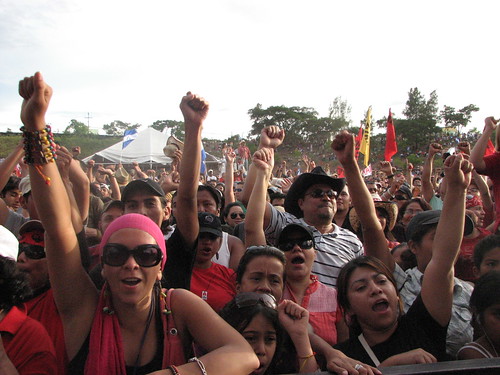
Near dawn on June 28 2009 the Honduran military shot its way into the Presidential residency of Manuel Zelaya and kidnapped the elected president of Honduras, forcing him out of the country and setting Honduras down the path that continues today. 

June 28, 2016 Tegucigalpa
Seven year later on June 28, 2016 and the dictatorship intensifies. The commemorations of its 7th year take place in the midst of intensified criminalization of the social movements, the reappearance of death squads, and threats, disappearances and murder of activists in impunity. Meanwhile Juan Orlando Hernandez consolidates control of not only the Executive branch and ministries but also the Congress, the Supreme Court and other judicial entities, the Electoral Tribunal and all the expanded military and repressive forces in the country. 
Tegucigalpa
The La Voz de los de Abajo fact finding and accompaniment mission, accompanied the mobilization for the coup anniversary in Tegucigalpa; there were other mobilizations around the country.  

La Voz accompanying CNTC on June 28, 2016
We met with Bertha Oliva of the human rights organization COFADEH who reiterated to us her view (also published in El Libertador newspaper on June 28) that Honduras has not recovered from the collapse caused by the overthrow of Manuel Zelaya’s government and that the institutional break down in the country has benefited the cupola of power and those running the country while the crimes against the opposition continue and are unpunished. The leaders and members of the indigenous Lenca organization COPINH and of the campesino organization the CNTC stressed that the big landowners, Congressional powers like the Vice President of the Congress, Gladys Aurora, and the Honduran and multinational corporations have all benefited from the last seven years of land grabbing concessions for mining and hydroelectric power and African palm production. 

Students mobilize June 27 at the University
(Photo from Honduras Tierra Libre)
The students and teachers in the country continue to be threatened, arrested and disappeared for opposing the privatization of education and the destruction of university democracy and autonomy. The government is shutting down oppositional media like TV Globo and journalists continue to be threatened and murdered. 


June 28 Tegucigalpa
On top of this, the population in general, especially the poor - who are a majority of the population are finding it more difficult everyday to put food on the table because of increases in costs and cuts in employment.  One young family man who works as a driver told us that just two months ago his family electricity bill was a little more than 700 Lempira a month ($35) and he had a full 30 days to pay it; the most recent bill was 1200 Lempira ($60) and the time to pay has been reduced to 15 days. We heard from people from Tegucigalpa and many other regions that Juan Orlando and his National Party continue to exploit the very poor very cynically with the “solidarity sacks” (bolsas solidarias); officials hand out small bags of basic food necessities ( a few ounces of salt, a pound of beans and rice) IF the recipient signs a National Party petition saying they favor allowing re-election. The list goes on and on - the number of outrages that we were told during our one week mission would fill many pages. 
June 28, 2016 Tegucigalpa
The resistance movement is debating strategy and tactics. While the social movements, reeling from the violence against them and the assassination of Berta Caceres, look to build regional struggles like the fight against the toll roads and to build national momentum from the grassroots struggles, part of the resistance looks toward a new electoral cycle with the hope of building and strengthening electoral opposition to put the brakes on the out of control and violent neoliberal assault. As well, part of the movement looks to do both.


Press interviews Mel Zelaya
at the march  
Juan Orlando has maneuvered to change the constitutional ban on re-elections for the Presidency and while everyone in the resistance opposes Juan Orlando’s re-election,  part of the LIBRE party is enthusiastic for the possibility of Manuel Zelaya being able to run for election again because they see that would make a real electoral opening for the people possible; others are vocal that the changing of the constitution without popular consultation along with running the risk of Juan Orlando consolidating himself in permanent power is unacceptable.  This controversy was apparent at the June 28th mobilization in Tegucigalpa where there were slogans being spray painted on the walls saying “We need Mel” and “We need Mel for President” at the same time that there were people chanting “No to re-elections”.  Zelaya was one of the speakers at the short rally and concert at the end of the mobilization. 
June 28, 2016 Tegucigalpa 

The mobilization in Tegucigalpa was full of life and spirit although smaller than some previous marches, but there had already been nearly daily protests of the students who are engaged in a fierce struggle with the Rector of the National Autonomous University system Julietta Castellanos and Juan Orlando, and the national teachers’ unions were preparing for an emergency mobilization on June 30th in what looks like renewed vigor in their fight over privatization, lay-offs and repression focused on their demand for a salary increase after the government announced very small increases. 

Nestor Aleman of COPEMH speaks
at Progreso rally
Finally,  with the murder of Berta Careers still so painfully present and the US election spotlighting Hillary Clinton, we found everyone eager to talk about the role of the US in the coup and its continuation and expansion by President Obama’s Secretary of State at the time, Ms.  Clinton and the role of US training and funding of military and police forces implicated in Berta’s murder. The new law introduced in the US Congress - The Berta Careers Human Rights Law- aimed at cutting US aid if human rights conditions are not met by the Honduran government has gotten wide press coverage in Honduras, including an article published in the main pro-government newspaper La Prensa on June 28th (from an EFE news agency article)  pointing at Chicago organizations, La Voz de los de Abajo and Chicago Religious Leadership Network on Latin America (CRLN) for working to get support for cutting the aid. 


Monday, June 27, 2016

La Paz - Resisting Criminalization

June 24-25th La Paz
V. Cervantes

We left Progreso early on Friday and took a bus to San Jose, La Paz.  Walking down the road towards the regional center I could see their new radio antenna tower rising up behind the building. La Voz de los de Abajo and Chicago’s Radios Populares have worked with the campesino radio project with the CNTC in La Paz for more than 8 years and we always check in with the local communities in La Paz. 

When we arrived a workshop was in progress with a lawyer from Via Campesina on the topic of the “law and the campesino movement”.  This is a timely topic for the campesinos and campesinas in La Paz where the criminalization of the campesinos is ferocious.  There are 18 local CNTC campesinos with arrest warrants currently, including the regional General Secretary,  and many more on probation — all for their participation in the agrarian movement to recuperate land for the small landless farmers. 8 members of one La Paz CNTC campesino group named after Honduran human rights defender Juan Almendares, spent three months in prison last year under very difficult conditions that affected their health. This included 3 members of the regional leadership committee of the organization. Nationally, the CNTC has 5 members in jail now and  thousands more who have been charged. 


When we sat down and talked to the campesinos and campesinas they told us that the government of Juan Orlando Hernandez is not only arresting more campesinos but also charging them with more serious crimes. A few years ago they would be charged with usurpation of land or theft and now for the same actions of recuperating land, they are being charged with terrorism, weapons charges (for having work tools like machetes) also,  the penalties for things like deforestation (for cutting down one tree) used to be minor but now can mean 4-7 years imprisonment.  

In early May of this year I accompanied a recently evicted La Paz campesino group called “9th de Julio” whose members had their houses destroyed and their crops burnt out, and two of their members wounded when police opened fire against them.  On Saturday we were invited by the regional CNTC to visit the “9th de Julio” again. We found that the campesino families have rebuilt all their houses and replanted some of their crops despite being under threat of another eviction and despite the existence of  arrest warrants against their members. The men and women in the community explained that they had taken land that was fallow and turned it into land that provided food, not only for their families, but enough to take to the local markets and sell. The community has more than 20 children and the families talked about the trauma for the children of having seen police and military come into their homes, destroying everything and firing weapons. They explained that they have to teach their children the importance and necessity of what they are doing and why they are organized. The president of the coop told us that they know that this struggle for the land is necessary for their survival; if they loose the land and homes they have worked so hard for they will have absolutely nothing and will be living on the side of the road. 

In the evening on Saturday we joined two of the compañeros who were on the air on Radio Suyuguare (a Lenca indigenous word that means land of hills and valleys). The communities in La Paz are overwhelmingly Lencan and the CNTC region embraces their cultural and traditions. The radio project has applied for a community radio license and broadcasts 7 days a week from 1 to 9pm. There is a team of mostly young campesinos and campesinas who take turns broadcasting and they have shows that talk about indigenous rights, the campesino movement, news, environmental issues and also play music and take dedications. It was impressive to see and hear all the calls and messages coming in during the broadcast, showing us that they have a strong audience in the region. Samuel and Orlando explained to us the importance of the radio project for their work in organizing and educating the communities, for making alliances with other community members who are not in the campesino movement and finally for them as young campesinos as an activity that has opened up new knowledge and opportunities to participate in national and regional networks and events. 

Environmental issues are extremely important in La Paz. The ruling party leader and Vice President of the National Congress is from La Paz: Gladys Aurora  and her husband are strong supporters and business partners with many of the big hydroelectric and mining projects already begun in the beautiful mountainous region. In fact there are projects named Aurora 1, Aurora 2, Aurora 3. The campesino communities strongly oppose the destruction of the indigenous territories and of the agricultural land that these projects bring but they told us that the government in partnership with the construction companies and international companies are waging a war against the opposition with bribery, false promises to bring positive development to the poor communities, threats and finally with assassinations like that of indigenous leader Berta Caceres of COPINH in the nearby province of Intibuca. 
On Sunday we will head to La Esperanza, Intíbuca to express our solidarity with COPINH and to  talk to COPINH and to Berta Caceres’ family about their struggle for justice. 


Friday, June 24, 2016

Progreso - Fighting Against Privatization and Repression


La Voz de los de Abajo has a fact finding and accompaniment commission traveling in Honduras this week.  We arrived Wednesday and driving from the San Pedro Sula Airport to Progreso we stopped to accompany the ongoing protests against the construction of a new toll road on the highway between these two important cities in the North at the invitation of some of the activists in this movement.   Recent protests on June 4, 8 and 11 have been repressed violently with tear gas, police beating participants and journalists and the detention of protesters who have set tires on fire to help block the road.  Wednesday the number of protesters was much smaller but they still blocked the highway, facing off against at least 50 armed National Police and Cobra riot police without any violence.  Organizations supporting the protests include the CNTC Progreso, ERIC-SJ, teacher activists, LIBRE, student groups and poor peoples organizations working together in the Mesas de Indignación.  The Chamber of Commerce of Progreso is joining in now;  they called for a civic strike Thursday the 23rd  of the small business owners and Progreso's population with a public assembly to discuss and debate what to do. More than 100 small and medium businesses supported the civic action.

Since taking power in January 2014 President Juan Orlando Hernandez has intensified the campaign of privatization of public goods and the cutting of services to the people. One of these campaigns is for the privatization of the major highways through the construction of toll roads. These toll road schemes bring in revenue for the private/public partnerships (Coalianza near Tegucigalpa and DASA in the North) that build and manage them through the contracts awarded to companies and the collection of the tolls themselves.  They cause immense hardship for the population and are widely hated and protested.  The cost of a toll is around $1 for a regular private car and approximately $10 for a large truck. At the same time the alternative roads are being blocked with drainage ditches and other construction. Toll roads have been completed on the highways in and out of Tegucigalpa and between San Pedro Sula and Choluma, and more are planned on the highways in and out of Progreso. There have been many protests blocking the road and refusing to pay the tolls but now people have decided to protest to prevent the construction of new tolls.
Padre Melo on the air Radio Progreso

Radio Progreso ERIC-SJ and the Teachers movement represented
LIBRE congressman Bartolo Fuentes, City council woman Araminta Pereira


One of the organizations working to build this rebellion against privatization of the roadways in Radio Progreso, and ERIC-SJ. We visited Padre Melo during his nightly show, America Libre. He was receiving calls from the public dennouncing the tolls and he called on the social movement organizations and resistance movement to make it a national movement. He believes that it is urgent for the popular movements to strengthen these broader civic protests so that they are less vulnerable to manipulation by the government.

Friday, June 17, 2016

COPINH - Unrelenting Rebellion - New Documentary Available Online

COPINH documentary released - Telling the story of the organization Berta Cáceres gave her life for


Tuesday, May 31, 2016

Businessmen collude with Honduran government to jail residents of Zacate Grande and displace them from coastal lands


For decades the communities of the Zacate Grande peninsula have suffered from constant harassment and arrests ordered by big businessmen and government functionaries.

Those who continue to resist pay with jail time, as is the case of Abel Antonio Perez and Santos Hernandez from the Puerto Sierra village in the Playa Blanca community, who were sent to the Nacaome penitentiary on May 19th, 2016. Both are peasant leaders and members of the Association for the Development of the Zacate Grande Peninsula (ADEPZA).

They appeared on Thursday at 2pm in front of the Amapala court for a sentence review hearing where Judge Iris issued a warrant for their arrest for not having showed up to sign the registry verifying their presence in the country.

They have several previous charges and arrests for the crimes of usurping land and building on the private land of José Casis Leiva and Edilberto Cruz.
 

Santos and Abel are part of a group of 44 families who are affected by the wall built by Edilberto Cruz, owner of the Puma gas station in San Lorenzo, who has been showing up with the Relleno and Nacaome police since May 14, 2011, to ask the people left inside of his wall to abandon the property that they live on.

Don Faustino Perez, Abel Perez’s father and now one of the two arrestees has been living on this land for over forty years, yet only has a certificate of use (dominio útil) to validate him as the owner of the land wher he lives, since the State always considered the Zacate Grande peninsula as private rather than national lands, which is why Don Faustino never received a title from the Property Institute or the National Agrarian Institute (INA).

Every year during Holy Week, Zacate Grande’s beaches fill up with visitors, and at Playa Blanca Santos and Abel helped clean up the beaches and parking areas for visitors. A few days later Jorge Casis Leiva accused them of using the area of his supposed property for parking. Now they are jailed for not have followed the court-ordered probationary measures stemming from the accusation.

The government’s hands have long been dirty for harassing and jailing peasant leaders and organizers. In 1902 the State bequeathed the Zacate Grande island to General Terencio Sierra as a reward for his good work as President of the Republic, who went on to grant it before his death through a colonial title to his Nicaraguan niece Carmen Malespin, giving her 500 lots of Zacate Grande lands, but never mentioning in the document what part of Zacate Grande those lands were in.

In 1970 the construction of an artificial land bridge connected Zacate Grande with the mainland and turned the island into a Peninsula. This and the building of the port of Amapala led big businessment and investors little by little to show up and take over ownership of the beaches, with Carmen Malespin giving her approval without having ever set foot on the island. She began to sell off small beachside lots, and that is how businessmen like the Facusses, Nassers, Rosentals, Kafatis, Canahuatis, Larachs, Maduros, and prominent functionaries linked to corruption such as Lena Gutierres, Juan Orlando Hernandes, Arturo Corrales, Leonardo Callejas etc. began taking ownership over the majority of the beaches of the peninsula.

After Callejas pushed through the 1992 Agrarian Reform law, 32 beaches were given away almost 70% of the peninsula was legally given over to Miguel Facusse Barjun, a businessman implicated in enormous thefts such as that of the National Investment Corporation (CONADI) who was also the uncle of ex-president Carlos Flores Facusse.

Miguel Facusse Barjun died in 2015, but amongst his heirs is his son Miguel Mauricio Facusse, who today is considered one of the two richest Hondurans in Central America, as well as his daughter Elissa Facusse, wife of Fredis Nasser, owner of Petrosur, majority investor in Grupo Terra, stockholder in the gasoline company Uno as well as DESA. As a wedding gift, Miguel Facusse gave his daughter ownership of the Gaviotas beach, leading to the brutal eviction of the Cárcamo Sanchez family, who lived on the beach, in 2003. Narda Ofelia Sanchez, after being sent to prison, won her case on three occasions and was never removed from her beach, yet to this day nobody has paid for the material damages suffered by the family nor the immense damage to Honduras as a country cause by the privatization of one of the most beautiful beaches of the Gulf of Fonseca, the Gaviotas beach.

Next to the Gaviotas beach is the Blanca beach and the village of Puerto Sierra, where since 2012 there have been warrants for the arrest of Faustino Perez, Santos and Abel, and Gabriel Moreno. The accusations were made by Edilberto Cruz, the supposed owner of the Uno Gas Station in San Lorenzo. On what is left of the community Jorge Casis Leiva has put up signs warning not to enter because it is his land, since he considers himself the owner of the whole community for having purchased it from the Malespin family.

Currently there are 36 accusations against residents of Zacate Grande for the same charges faced by Santos and Abel – usurping land, damaging the environment, and building on private land. At any moment any of them could go to jail for not complying with measures such as showing up to sign the court registry or not having the money they have to come up with every month so they can make the trip.


Related Posts with Thumbnails