Tuesday, May 31, 2016

Businessmen collude with Honduran government to jail residents of Zacate Grande and displace them from coastal lands


For decades the communities of the Zacate Grande peninsula have suffered from constant harassment and arrests ordered by big businessmen and government functionaries.

Those who continue to resist pay with jail time, as is the case of Abel Antonio Perez and Santos Hernandez from the Puerto Sierra village in the Playa Blanca community, who were sent to the Nacaome penitentiary on May 19th, 2016. Both are peasant leaders and members of the Association for the Development of the Zacate Grande Peninsula (ADEPZA).

They appeared on Thursday at 2pm in front of the Amapala court for a sentence review hearing where Judge Iris issued a warrant for their arrest for not having showed up to sign the registry verifying their presence in the country.

They have several previous charges and arrests for the crimes of usurping land and building on the private land of José Casis Leiva and Edilberto Cruz.
 

Santos and Abel are part of a group of 44 families who are affected by the wall built by Edilberto Cruz, owner of the Puma gas station in San Lorenzo, who has been showing up with the Relleno and Nacaome police since May 14, 2011, to ask the people left inside of his wall to abandon the property that they live on.

Don Faustino Perez, Abel Perez’s father and now one of the two arrestees has been living on this land for over forty years, yet only has a certificate of use (dominio útil) to validate him as the owner of the land wher he lives, since the State always considered the Zacate Grande peninsula as private rather than national lands, which is why Don Faustino never received a title from the Property Institute or the National Agrarian Institute (INA).

Every year during Holy Week, Zacate Grande’s beaches fill up with visitors, and at Playa Blanca Santos and Abel helped clean up the beaches and parking areas for visitors. A few days later Jorge Casis Leiva accused them of using the area of his supposed property for parking. Now they are jailed for not have followed the court-ordered probationary measures stemming from the accusation.

The government’s hands have long been dirty for harassing and jailing peasant leaders and organizers. In 1902 the State bequeathed the Zacate Grande island to General Terencio Sierra as a reward for his good work as President of the Republic, who went on to grant it before his death through a colonial title to his Nicaraguan niece Carmen Malespin, giving her 500 lots of Zacate Grande lands, but never mentioning in the document what part of Zacate Grande those lands were in.

In 1970 the construction of an artificial land bridge connected Zacate Grande with the mainland and turned the island into a Peninsula. This and the building of the port of Amapala led big businessment and investors little by little to show up and take over ownership of the beaches, with Carmen Malespin giving her approval without having ever set foot on the island. She began to sell off small beachside lots, and that is how businessmen like the Facusses, Nassers, Rosentals, Kafatis, Canahuatis, Larachs, Maduros, and prominent functionaries linked to corruption such as Lena Gutierres, Juan Orlando Hernandes, Arturo Corrales, Leonardo Callejas etc. began taking ownership over the majority of the beaches of the peninsula.

After Callejas pushed through the 1992 Agrarian Reform law, 32 beaches were given away almost 70% of the peninsula was legally given over to Miguel Facusse Barjun, a businessman implicated in enormous thefts such as that of the National Investment Corporation (CONADI) who was also the uncle of ex-president Carlos Flores Facusse.

Miguel Facusse Barjun died in 2015, but amongst his heirs is his son Miguel Mauricio Facusse, who today is considered one of the two richest Hondurans in Central America, as well as his daughter Elissa Facusse, wife of Fredis Nasser, owner of Petrosur, majority investor in Grupo Terra, stockholder in the gasoline company Uno as well as DESA. As a wedding gift, Miguel Facusse gave his daughter ownership of the Gaviotas beach, leading to the brutal eviction of the Cárcamo Sanchez family, who lived on the beach, in 2003. Narda Ofelia Sanchez, after being sent to prison, won her case on three occasions and was never removed from her beach, yet to this day nobody has paid for the material damages suffered by the family nor the immense damage to Honduras as a country cause by the privatization of one of the most beautiful beaches of the Gulf of Fonseca, the Gaviotas beach.

Next to the Gaviotas beach is the Blanca beach and the village of Puerto Sierra, where since 2012 there have been warrants for the arrest of Faustino Perez, Santos and Abel, and Gabriel Moreno. The accusations were made by Edilberto Cruz, the supposed owner of the Uno Gas Station in San Lorenzo. On what is left of the community Jorge Casis Leiva has put up signs warning not to enter because it is his land, since he considers himself the owner of the whole community for having purchased it from the Malespin family.

Currently there are 36 accusations against residents of Zacate Grande for the same charges faced by Santos and Abel – usurping land, damaging the environment, and building on private land. At any moment any of them could go to jail for not complying with measures such as showing up to sign the court registry or not having the money they have to come up with every month so they can make the trip.


Thursday, May 26, 2016

From the Aguan Valley: La Lucha Sigue

May 9, 2016, meeting with campesino
organizations in Tocoa, Colon
Article and photos by Vicki Cervantes
Video: Massacre en El Tumbador courtesy of Alto Al Riesgo, written and directed by Laura Bermúdez. 

On May 24, 2016 at around 6:30 in the morning, Jinson Aldin Alfaro Almendares, a young member of the campesino group Empresa Campesina Gregorio Chávez was shot in the back without warning by private paramilitary guards working for COFRUCO, a large land holder in the Aguan, as he worked in his fields. The COFRUCO plantation as well as the land Jinson was working are next to the Paso Aguan plantation controlled by the Faccusee family's corporation Dinant. The Paso Aguan plantation and the nearby community of Panama have been the scene of many attacks on local campesinos including the murder in 2012 of Gregorio Chavez, which has never been investigated and remains in impunity.   Jinson survived, but this incident is one of many, recent attacks against campesinos and their organizations. The day before the shooting, the home of the coordinator of the campesino umbrella organization the Regional Agrarian Platform for the Aguan Valley, Jaime Cabrera was surrounded for a time by armed men wearing ski masks while Jaime was inside the house. Police refused to take action against the guards who shot Jinson. (Information on the attack as reported by the Plataforma Agraria del Aguan via Karla Zelaya). 

In Guadalupe Carney on May 9, premier of documentary
of 2010 El Tumbador massacre of 5 campesinos

Just two weeks ago, I participated in an International Human Rights Observer Mission organized by COFADEH (May 6-12) that met with campesino organizations in the Aguan, including the Movimiento Revindicador Campesino Gregorio Chavez, Movimiento Unificado Campesinos del Aguan (MUCA) Movimiento Authentico Revindicador Campesino del Aguan (MARCA)  and the Permanent Human Rights Observatory of the Aguan (OPDHA).

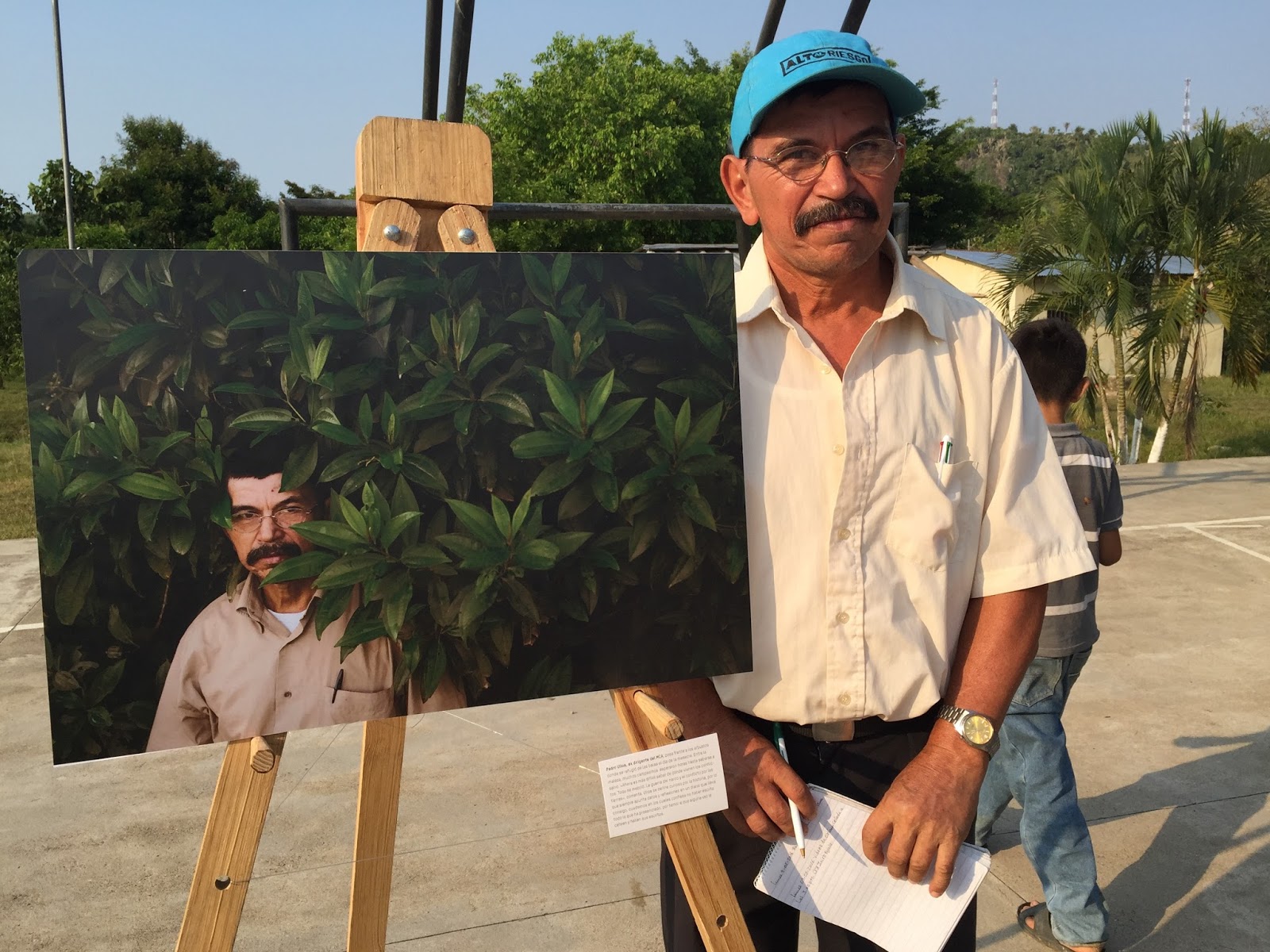
That same day we also participated in an event to commemorate and launch a new struggle to demand justice for the November 2010 massacre of 5 campesinos from the MCA by guards working for DINANT.  COFADEH has been working with the survivors of the massacre and the families of the murdered campesinos and is getting ready to take the case to the international justice system. The event held in the community of Guadalupe Carney included a photo exhibition of the survivors and victims and the premier showing of a new documentary about the El Tumbador.

May 9, Meeting with survivors and victims
of 2010 massacre at El Tumbador 
The meeting with campesino organizations, social movement organizations such as the Coordinator of Peoples' Organizations of the Aguan (COPA), and community organizations from the towns in the region who are defending the environment from mining and mega-tourism projects took place in the town of Tocoa. Participants in the meeting gave moving testimony about the violence, including murders, against campesinos, and different trickery and pressure being used to facilitate campesino lands passing into the hands of the large landowners and agro-businesses. Testimony also denounced what is seen as a new phase in the violence in the Aguan in which large scale violent attacks have been replaced with a more selective violence, infiltration of communities, threats and intimidations to terrorize and disorganize all opposition to land grabbing, mining and dispossession of the poor residents of the Aguan.

MUCA leaders speaking
MUCA leaders talked about the establishment of outright death squads, one group calls itself "head collectors of Colon"; on September 1, 2015 after police attacked a local protest with live ammunition and tear gas, a Coronel was reported to have said that he wanted the heads of two campesino leaders which he named by their names. Around the same time a 'hit list' came to light with more names of leaders and activists. Environmentalists, members of organizations opposed to the coup and current government also spoke of threats they are receiving. Employees of the National Agrarian Institute spoke of being threatened personally and having their jobs threatened because they support campesinos or because they belong to LIBRE (the left opposition party). Another woman who works for the municipality but is opposed to mining concessions that will affect her community. She was told at work that her job was at risk and that furthermore that bad things happen to people working against mining.

Members of the human rights observatory (OPDHA) also gave testimony about recent attempts on their lives. Irma Lemus and Rigoberto Duran were run down by a car that was obviously waiting for them as they rode by on Rigoberto's motorcycle. Both suffered serious injuries. There were previous incidents in which cars with darkened windows and without license plates followed them and attempted to intimidate or run them off the road. Campesino activists and members of COPA and other social movements emphasized that Juan Orlando Hernandez's government is firming up a dictatorship that is "asphyxiating" the campesinos and that there is a strong alliance between National Party politicians, big businessmen, judges and police against the campesinos in the Aguan.


Tuesday, May 24, 2016

GLOBAL ACTION FOR BERTA JUNE 15th

JUNE 15th - GLOBAL ACTION FOR JUSTICE FOR BERTA CÁCERES
To the grassroots social movements, organizations and civil society around the world:

The death of Berta Cáceres has filled us with indignation. We carry the pain with us, but we also carry the strength of her thought, her work, and the longing for justice. The principles that she fought for are what will save humanity, which is why we call on you to participate in a worldwide protest that will bring all of our voices together to demand justice for Berta Cáceres, justice for Gustavo Castro, justice for COPINH and justice for the people of Honduras.

On June 15th in Honduras social movements and organizations, institutions and people of action will protest to demand the immediate creation of an independent investigative body to transparently, deeply and completely investigate the assassination of our sister and compañera.

On that day we would like our sisters and brothers from other countries in the world to join us by carrying out protest actions in front of the Honduran embassies of your respective countries to demand the following:
  • The immediate creation of an international, independent investigative body sponsored by the Inter-American Human Rights Commission to seek the truth about thise vile crime and assure that all responsible parties are prosecuted.
  • The immediate and definite cancellation of the concession given to DESA, the company building the Agua Zarca hydroelectric project in Río Blanco.
The actions carried out by the Honduran state and its organizations are insufficient and are not aimed at achieving justice. On the contrary, they are assuring that this crime will go unpunished.
Let’s join together and put an end to death, impunity and injustice.

With the ancestral strength of Berta, Lempira, Mota, Etempica and Iselaca we raise our voices full of justice freedom, dignity and peace!

Justice for Berta is Justice for the World!
Wake up humanity, there’s no time left!

Civil Council of Popular and Indigenous Organizations of Honduras
COPINH

Wednesday, May 18, 2016

Tegucigalpa - Forum on Human Rights in Honduras


On May 12th, the International Human Rights Observation Mission organized by COFADEH held a forum in Tegucigalpa to present its key preliminary findings and recommendations. The forum was attended by a large group of social movement rank and file and leaders including campesino organizations, teachers' unions, LGBTI, LIBRE, human rights defenders, journalists, and indigenous rights defenders (see my photos here).  The family of Berta Caceres participated from the podium. Below this introduction I am posting the English translation of journalist Giorgio Trucchi's report on the forum with a link to the original Spanish.
One of the participants in the open discussion at the  forum was Sandra Zambrano of the LGBT HIV education organization, APUVIMEH, who talked about the attacks on the LGBTI community,  well known activists like Victoria Gomez Cruz who was the first transgender woman to run for office in the primary elections for LIBRE in 2013 have had to leave the country due to threats on their lives. She also talked about the constant threats and pressures against organizations and individual defenders of human rights for LGBTI community. She and her brother José have had move two members of their family out of the country. Sadly, after the forum on May 14th came the news that Allan Yoni Banega Godoy, nephew of Sandra and José was kidnapped and later found dead in Tegucigalpa. 
Also participating in the same discussion were members of a parents and family organization "Madres y Padres de Familia" that are organized to support and defend the student movement, especially around the attacks on public education and the very violent response of the JOH government to the protests of the last few weeks. The Madre y Padres reported that in the last 3 weeks alone there have been 5 students murdered after participating in protests. They are mostly high school students and the wave of protests has to do with a new "educational reform" that requires public high school students to find two illiterate adults and teach them to read, also paying the adults their transportation costs, a meal and other expenses. Most of the public high school students come from poor families and absolutely cannot afford to pay these costs. The head of the high school teachers union (COPEMH) Jaime Rodriquez was also at the Thursday forum and he added that teachers are being accused of inciting the students and being threatened also. A week ago the JOH Education Ministry suspended Jaime's teaching license because he has been supporting the students. The suspension of his license means that he will not receive any salary. Jaime also denounced strongly the terrible violence against the youth and noted that earlier deaths of student activists remain in impunity, for example Nicole Soad Bustillo, the 13 year old murdered  a year ago, shortly after she publicly insulted and denounced Juan Orlando at a student protest. On Friday, May 13th there were reports that the student organizations in San Pedro Sula had negotiated some agreements with the Ministry of Education that may end up resolving this most recent conflict, but the struggle to defend public education will continue. The Radio Globo journalist David Romero also spoke from the floor about the criminal defamation cases against him used as a method to try and silence his voice against the government and about the violence and harassment against journalists in general. The precarious position of journalists was further illustrated by the presence of Felix Molina, journalist and community radio organizer who survived two attempts on his life on May 2nd.  -V. Cervantes  
Human Rights Hit Bottom in Honduras
by Giorgio Trucchi, May 16, 2016
Managua, Nicaragua (Conexihon)

G. Trucchi
On May 12th, as part of the International Mission for Human Rights Observation, a Forum on Human Rights in the Aguán was held in Tegucigalpa. During the activities the main findings of the Mission were presented and recommendations made, and the basis was laid for the creation of an analytic space to prevent risks for human rights defenders. 

“We are living in very difficult moments and we must work to avoid a deepening of human rights violations in Honduras,” said Bertha Oliva, Coordinator of the Committee of the Families of the Disappeared Detainees in Honduras (COFADEH) during her speech at the opening of the Forum. 

“We are putting forth all of our positive energy and we are ready to gather and transform memory, not in pain, but as a collective proposal,” stated the human rights defender.

Organized by COFADEH and made up of delegates from organizations in Europe, the United States and Latin America, among them REL-UITA(1), the Mission presented its findings to the national and international community and formulated recommendations for the State of Honduras. 

The Extractive Model - Death Projects 
According to members of the Mission, in the Lower Aguán Valley, “threats, attacks and assassination attempts continue” against campesino leaders, human rights defenders, community leaders and defenders of natural resources that are threatened by the extractive projects.”

The acceleration of granting concessions of territories in the upper regions of the Aguán Valley to mining companies, on top of the uncontrollable expansion of African Palm as a mono-crop, is responsible for an interminable wave of assassinations in the framework of an agrarian conflict that originates from the lack of access to land for thousands of campesino families. The effects of mining on water sources will deepen the social conflict and violence. 

The criminalization of the struggle for the defense of the territories and human rights as well as the systematic threats, displacement and forced evictions, exile, torture and dispossession “remain in total and absolute impunity.”, states a press communique from the Mission. 

Criminalization and Repression — Crushing Human Rights
The ever more selective persecution is participated in by “private security forces and death squads protected by the State that has militarized the region with the sponsorship and to the benefit of the regional economic powers.”, states the communique. “Sadly, we note that not only have many of the recommendations made some years ago not been implemented but that the statistics on murders have risen and impunity is absolute”, said Luis Guillermo Pérez, member of the International Human Rights Federation (FIDH). 

There is a perception of a lack of will and an investigative conflagration that was corroborated in a meeting of the Mission with local and regional authorities and that continues to repeat  and deepen the criminalization of the campesino organizations. 

Esly Banegas, from the Coordination of Popular Organization of the Aguan (COPA) explained that of the campesino leaders that signed the agreements of 2010 with the government, the immense majority have been assassinated or had to flee into either internal or external exile. 
“More that 300 colleagues are in judicial processes. They are criminalizing and assassinating us. If we don’t unite they will decimate us until we disappear.”,  said Banega sounding the alarm. 
She also noted that the agreements of 2010 as well as those of 2012 (2) for the purchase of thousands of hectares of land were never fulfilled. 

“The campesino enterprises are confronting a grave economic crisis, the product of the international price for palm oil and the lack of will on the part of the current government to create a consensus for a reduction of the (campesino ) debt. If this problem is not resolved, the situation could return again to an explosive situation”, said the leader of COPA. 

Given this situation, a demand by the Mission was proposed by the Forum: the creation of a grouping to formulate analysis to prevent risk for human rights defenders. 

Justice for Berta - No More Violence Against Copinh
The International Mission for Human Rights Observation also strongly took up the theme of the assassination of the Lenca indigenous leader, Berta Cáceres, calling it a “political crime for which the State is responsible, not only because an army official has been linked to the crime but because the State” was obligated to protect her life and physical integrity. ”
The Mission stated that it joins the call of the family and of the Civic Council of Popular and Indigenous Organizations of Honduras (Copinh) to create an international investigative commission that is autonomous from the Honduran State, “so that all the material and intellectural authors of the crime are punished”. 

The Mission also condemned the police repression unleashed against Copinh’s protests on May 9th and demanded that the government of Honduras “avoid all forms of criminalization of social protest”. 

Recommendations - The right to truth and justice is primary
Among the main recommendations formulation by the Observation Mission notable is that of the “assurance of an investigation of the crimes committed “as the premise for the guarantee of the right to truth, justice and reparation/restoration for the victims”. 
As well, that the Honduran government assures the fulfillment of the agreements signed with the campesino organizations of the Aguán, that the repression and stigmatization does not continue against those who defend their rights, as well as the guarantee of strict fulfillment of the preventative measures ordered by the Inter-American Human Rights Commission (IAHRC). 
Finally, it recommends the creation of mechanisms for a participatory consultations with the campesino organizations “related to the projects that are implemented in their territories”. 


Thursday, May 12, 2016

Violent evictions today and campaign against international observers


May 11
The Human Rights Observation Mission spent most of the day traveling from the Aguan Valley back to Tegucigalpa where there will be a public forum on Thursday to discuss the Mission’s finding but we received news of more repression and new government attacks on human rights defenders and journalists.  

This morning, in Tutule, La Paz two campesinos from the campesino group 9th of July (9 de Julio) community were wounded when 12 police vehicles and 80 soldiers carried out a violent eviction, using bulldozers to destroy houses, crops  of fifty families who have lived and worked on the land for 7 years. The security forces fired live ammunition wounding Johnny Alfredo Mejia Torres and Edwin Murillo. At the same time  5 patrol cars arrived at the home of Wilman Chávez, General Secretary of the La Paz region of the Central Nacional de los Trabajadores del Campo (CNTC) to arrest him. 

Franklin Almendares
photo from conexihon
The National General Secretary of the CNTC, Franklin Almendares reported to the media that the men, women and children of the community were forced to run and attempt to hide in the mountains from the troops. He also reported that this eviction is to benefit a local political power, Carlos Arriaga. In a phone interview with Franklin Almendares  this evening he said that the two wounded men received treatment and will recover and that there is a court hearing tomorrow morning for those who were arrested. He called for human rights organizations both national and international to accompany the community and their organization. 


In Tegucigalpa, the General Secretary for the Administration of the Government, Jorge Ramón Hernández Alcerro held a press conference where he condemned international observers and press for “inciting violence” referring to the protests this week by COPINH that were repressed by the police. He said that he was instructing the Honduran immigration service to identify foreigners who are participating in the protests or inciting violence. At least one international observer, Giulia Fellin who has been accompanying COPINH was harassed and interfered with as she tried to go to her embassy today. Another National Party politician claimed that foreign journalists are inciting violence, creating images and causing problems for the government. With this the government continues the campaign of defamation against human rights defenders, journalists and international solidarity and opens the door to more repression against those groups as well as inciting violence against them. 
Related Posts with Thumbnails