Sunday, October 4, 2015

"We can't be indifferent to the defense of our environnment"

Chance for Justice: Trujillo, Colon
October 4, 2015
Environmental Justice in Honduras
V. Cervantes

The retrial of Chabelo Morales Lopez is recessed until October 19th; our group remains accompanying the family in the community of Guadalupe Carney but we decided to make a visit to the small city of Trujillo close to Guadalupe where we arrived in the middle of the "day of the environment" action.

Trujillo is an old Spanish colonial city right on a beautiful bay on the sea. It is a part of the Garifuna coast where the Garifuna people have ancestral rights to the coast under international and national agreements. It is on the edge of of the Aguan Valley's fertile palm growing region, home to thousands of campesinos and their communities as well as to the wealthiest landowners in the country like Miguel Facusse, Reynaldo Canales and Rene Morales: perpetrators of incredible violence against campesino and Garifuna groups in the region.

Another piece of the land conflicts in the region has to do with the struggle to protect the environment and includes the concerns of most of the residents of the area about the destruction caused by mining, tourism and mega-agricultural projects.

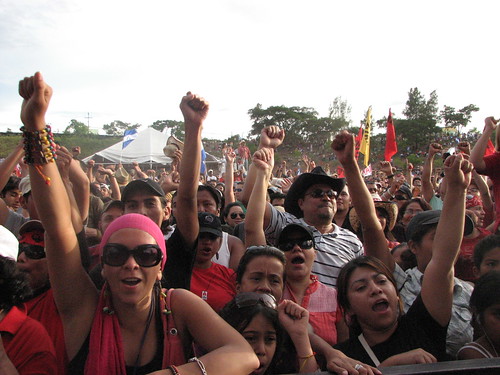
The action we saw today was part religious procession, part parade and part protest march with several hundred people carrying placards and banners, children dressed as animals riding on colorfully decorated "floats" created on pick-up trucks. The paticipants were Garifunas, campesinos, school children, nuns, and a variety of Trujillo residents. I spoke with one of the participants who told me the Catholic church in Trujillo was the main organizer of the action with the participation of a lot of different people.  They were chanting slogans such as "no puede ser indiferente--a la defensa del ambiente" (you can't be indifferent to the defense of the environment) and against the new (2013) mining law which granted more concessions to private mining companies. Around 35% of the total country is now concessioned to mining and hydroelectric projects. Communities, especially indigenous and rural communities, all over Honduras are resisting displacement and/or the contamination of their water and soil. In the Trujillo area there are dozens of mining concessions that the people oppose. We talked earlier in the week to one of the long time campesino leaders at Guadalupe Carney who is part of a regional group organizing to resist the mining companies and the Honduran government and keep mining out of the area.

Another big environmental and land tenancy issue is related to the attempts
to develop mega-tourism in the area. Randy Jorgensen (the Canadian porn king millionaire) is one of the highest profile "developers". He is leading an aggressive and threatening push to displace the Garifuna communities in the Trujillo area so that he and his investors can take over the beaches for cruise ship landings and high end large tourist resorts. This kind of development  degrades the fragile environment in the area as well as displacing the indigenous Garifuna from their land and destroying their way of life and stability.  So far the communities have resisted despite threats of violence and it was good to see the different groups whose lives are affected joining together.

The UK based group, Global Witness, issued a report earlier this year that showed that Honduras has had the highest per capita rate of people murdered because of their activities to defend the earth and environment, for each of the past five years, than any other country in the world. In 2014, three quarters of these murders were in Central and South America, including 12 in Honduras. Global Witness reported that world-wide these murders and conflict in general are increasing because of the intensifying competition over land and land use and the fact that the lack of government action to protect people or environment is putting the ordinary residents and their organizations on the front lines of the conflict.


Friday, October 2, 2015

Chance for Justice Day 5

Vicki Cervantes of La Voz de los de Abajo and HSN is accompanying Chabelo Morales' new trial for two weeks along with Karen Spring of the HSN and other international observers. 

Friday, October 2, 2015
V. Cervantes

Thursday evening the electric power went out in Guadalupe Carney and with no television, radio or lights for distraction, some folks went to bed very early, while some of us stayed up burning through candles, telling stories about the history of the community, and sharing rumors and gossip about the powerful military figures and oligarchs active in the Aguan. One of the young campesinos talked about how after taking over the land that had been a US military facility, the campesinos found graves, ammunition shells, and more on the lands. I remembered that not long after the land recuperation the La Voz de los de Abajo was given a copy of military documents found by the MCA campesinos at Guadalupe that included a list of Honduran, Nicaraguan and Salvadoran prisoners who had been held in the clandestine detention center run by the US and Honduran military at the base. The young campesino told us the story that circulated in Guadalupe in those early days about a campesino ghost with high rubber boots full of water who could be heard walking around near the village. For sure there are many ghosts, victims of the military, oligarchs, and big land lords past and present, who are still walking the valley, looking for justice.

Early in the morning Friday it started pouring rain and everyone was worried about how the rain might keep supporters away from the courthouse. Amazingly, the sky cleared and we piled into the back of a pick-up truck ourselves for the short ride from Guadalupe Carney to the court in Trujillo. When we got there Chabelo and the Morales family were happy to see that a sizable group of campesinos and campesinas from Guadalupe Carney and supporters from the San Alonzo Foundation and the Human Rights Observatory of the Aguan were there waiting for Chabelo to arrive. The defense team accompanied by members of ERIC-SJ and Radio Progreso arrived shortly and the trial began. 

Day 5 in Court:
Today two prosecution witnesses appeared but the testimony again was limited to forensic details regarding ballistics analysis and once again there was no evidence was presented linked to the accusations against Chabelo. After about an hour the testimony was complete and the judges announced that the trial would adjourn for the day and not convene again until October 19 because there were still problems in locating important prosecution witnesses and October 7,8, 9 are holidays and the court decided not to work those days. The defense lawyers objected to the fact that the prosecution witnesses,especially the key witness, Henry Osorto, were not complying with orders to appear in court and asked for the court to issue edicts requiring their presence and if they don’t show up to go ahead and let the defense present its case. They also proposed that if Henry Osorto fails to show up again he lose his status as victim (which implies a certain leniency towards his no-shows). After much conferring among themselves the judges agreed to set a schedule so that defense witnesses could know when they will be called and to issue edicts for all scheduled witnesses to appear. Under Honduran law ignoring the orders to appear can result in charges of “disobedience” to the court similar to “contempt of court” charges. 

PRESS CONFERENCE: “URGENT TO CONTINUE ACCOMPANIMENT AND SUPPORT”
After the court adjourned, the defense team, international and Honduran supporters and one of Chabelo’s brothers, Merlin Morales headed to Tocoa, the main city in the Aguan Valley, about an hour away from Trujillo, for a press conference that was facilitated by a lawyer from ERIC-SJ, Brenda Mejia who has been observing the trial since it began. 

At the press conference defense lawyers, Omar Menjiva and Sara Aquilar explained what was going on in the court and the significance of the delays. Sara spoke eloquently about the symbolic importance of Chabelo’s case for the campesino movement and emphasized the urgent need for international observers and local supporters to continue to accompany Chabelo, his family and the community despite the obstruction and delays.

The Guatemalan jurist accompanying the trial, Dr. Henry Monroy, also spoke and noted strongly his view that the case of Chabelo is an example of the criminalization of social protest, in this case the just struggle for land -- the agrarian movement. He called for a regional solidarity presence from Central America and denounced the fact that intimidations against the family and Chabelo continue, including strange men appearing in the community near family homes and following vehicles.


Thursday, October 1, 2015

From Honduras: Chance for Justice #2

 Chabelo’s Trial - Day 4
Thursday, October 1, 2015


V. Cervantes

It was already dark Wednesday evening when we got off the bus at the entrance to the community of Guadalupe Carney on the highway to Trujillo. We walked through the community, quiet except for the dogs and roosters announcing our arrival, to the house where we are staying while we accompany Chabelo, his family and community during this trial.

During the bus ride we were listening to Radio Globo’s audio broadcast of a video from a very violent eviction of campesinos in Palomar, near Choluteca, by the National Police in which one campesino was killed and many injured. The audio was chilling with women and children screaming, people yelling and the noise of tear gas and people running. Those sounds were still ringing in my ears as I looked at the community that has been a symbol of success for organized campesino recuperation of lands since its beginnings 15 years ago when 900 families moved on to an abandoned joint US/Honduran military base. Despite evictions, assassinations, and all the problems that affect the poorest campesinos, the community persisted and fought to win titles to most of the land they cultivate; only two landowners continue to dispute the campesinos’ right to the land, the most powerful landowners in Honduras, the Facusse  family, and former military death squad member, now a police commissioner, Henry Osorto.

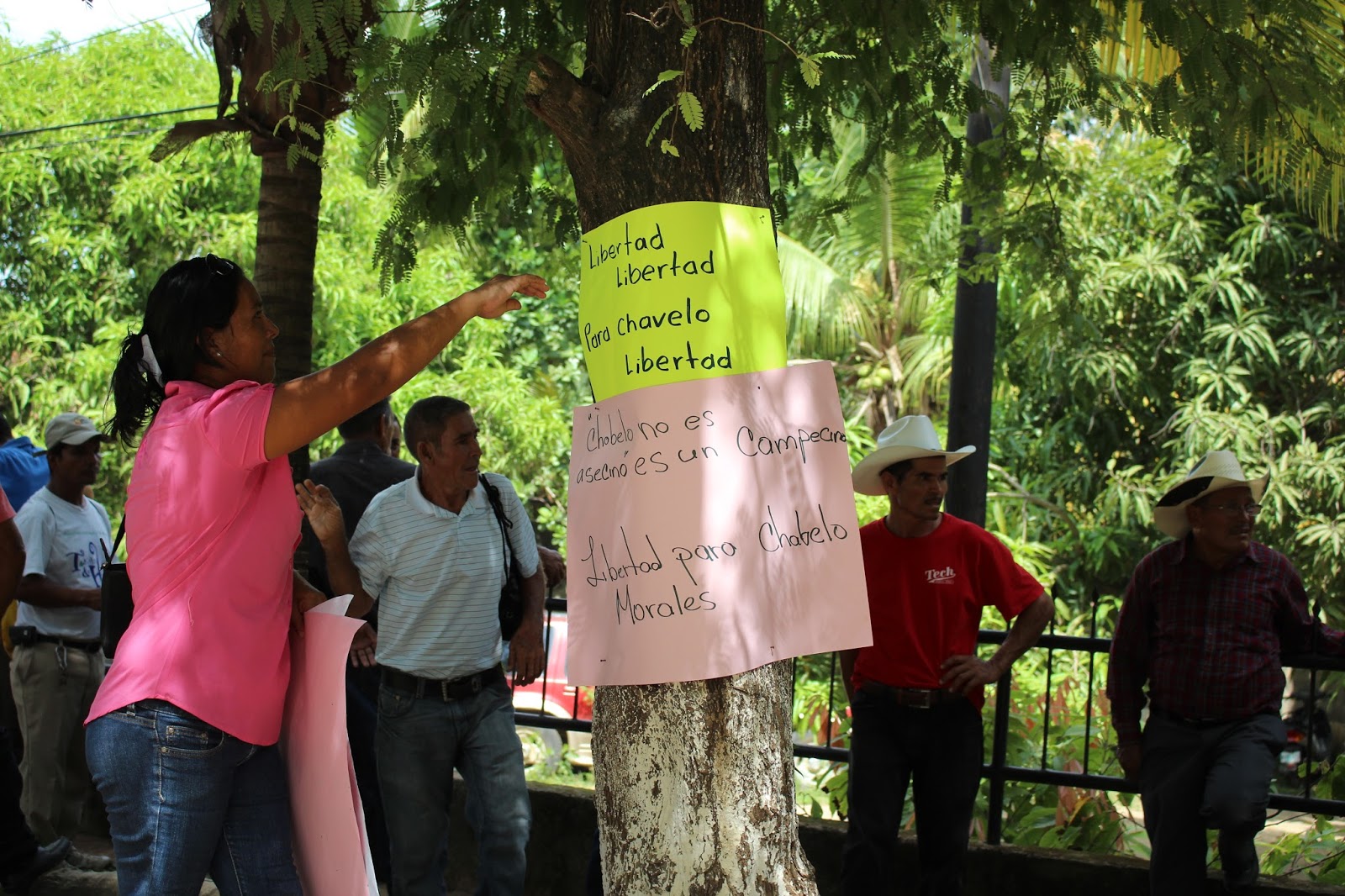
Today, Thursday, the Morales family and supporters from Guadalupe Carney, the Human Rights Observatory of the Aguan, COPA, Fundacion San Lorenzo and other campesino movements in the Aguan mobilized early to get to the court in Trujillo before 9am. Only a handful of people were allowed into the courtroom to observe, but everyone else continued their accompaniment by hanging up banners and placards in from of the court and maintaining a visible presence, keeping an eye on the 8 or so armed soldiers who were standing watch outside. In the courtroom we watched the panel of judges file into the room and call for the prosecution witnesses. One witness appeared, a doctor who received the body of Carlos Manrique Osorto; the doctor read out loud his original statement which details the injuries but, of course, has no information or evidence relevant to the charges against Chabelo. That testimony lasted about 20 minutes then it was announced that none of the other prosecution witnesses had come to court, including Henry Osorto  and that the trial would reconvene tomorrow morning.


The trial so far, like the previous 2 trials, has seen no concrete evidence presented linking Chabelo to the death of Carlos Manrique Osorto and has been marked by the failure of witnesses called by the prosecution to show up to testify. Henry Osorto himself has missed two scheduled appearances. (See the report from Greg McCain below for Tuesday and Wednesday’s court sessions).

Of course, we can only imagine what would happen if campesino witnesses ignored the summons to court to testify, but it is unlikely they would be allowed to delay a trial the way the prosecution witnesses are doing.

It seems that these delays, that may now stretch out the trial through the end of the month, are part of a strategy to wear out the supporters; reduce the number of international observers and hope that the Honduran media and people lose interest in Chabelo’s chance for justice. This is important also because attempts to intimidate defense witnesses and fear of violence against Chabelo, his family and the community to prevent a verdict in his favor continue.


This afternoon, we gathered with Chabelo and his family members and were watching the news on TV Globo when the video of the eviction in Choluteca was aired. We were frozen with outrage and sadness, watching the police attack the campesino community, mostly women of all ages and a few young men and small children. The women rushed to defend the community members being beaten and one woman passed out with blood seeming to pour out of a head wound. The policeman stood over her and a young man lying on the ground,  with his combat style nightstick still raised. The TV Globo commentator was indignant and cited the statistics that there is enough land for everyone in Honduras to have 20 manzanas (50 acres) of land.  One of Chabelo's brothers turned to me to say, imagine what we could do if everyone had land like they are saying,  but the big landowners and government only want to do that, and he pointed at the violence on the screen.


Link to another broadcast of the Choluteca eviction video

We also got word that today there were multiple protests blocking streets in Tegucigalpa as students, youth and other resistance members continued the protests against Juan Orlando Hernandez. The police violently displaced all the blockades.
----------------------------------------------------------------
Greg McCain
Defensor Internacional de Derechos Humanos Honduras

September 30, 2015
Yesterday, after the lunch time break, the trial resumed with a witness for the prosecution. It was an investigator from the DNIC, his testimony was intende to basically to back up one of the protected witnesses' testimony. Instead he added to the inconsistency of the testimony by stating that the protected witness stated that he could identify with 100% certainty who killed Enrique Osorto, the man Chabelo is accused of killing. The problem being that the protected witness has changed his testimony on several occasions, unable to identify Chabelo until instructed to by investigators.

This was the only testimony given before the hearing ended for the day. The other witnesses for the prosecution didn't show up so the judges adjourned for the day.

Today, the trial started around 9:30am.
Again only one prosecution witness showed up. This was a fireman from Trujillo who got to the scene after the fact. He wanted to read his testimony from a notebook that he brought in, but the judges told him he needed to tell it from his own memory. He basically offered nothing to the prosecutor's case against Chabelo.

The judges wanted to offer suggestions on how to proceed in light of the prosecution witnesses not showing nor being able to state when they will show up. This includes Henry Osorto. The Prosecutor informed the judges that Osorto was upset with being expected to state exactly when he would show up stating, "he is concerned for his saftey and can't give specifics in advance." This from a police officer who has recently been promoted to a police commissioner thus having the entire police force at his disposal.

It was finally decided that the hearings would proceed tomorrow and Friday. If the two protected witnesses didn't show  the prosecution agreed to give up that evidence. The judges then stated that after this Friday the trial would be suspended until Oct 19th so that the Prosecution could have ample time to have their agenda for witnesses in place. Nevermind that they had 2 months since the initial hearing to get their agenda in place, let's see what they accomplish in 19 days.

After the hearing I spoke with one of the international jurists who are here to observe. He stated that it appeared to him that it was obvious manipulation of judicial proceedings on Osorto's part and that the judges had the power to order him to testify on a specific date.

In the meantime, more suspicious men have been seen walking around Guadalupe Carney. Yesterday, two of Chabelo' sisters saw a man enter the yard of Chabelo's mom stood there for awhile than wandered off.


Tuesday, September 29, 2015

Another chance for Justice - Chabelo Morales

Thirty-two organizations signed a letter of support, demanding freedom for campesino political prisoner, Jose Isabel "Chabelo" Morales Lopez as his third trial on the same charges begins.

 La Voz de los de Abajo will join others in accompanying the trial later this week. On Monday September 28th, organizations from the region including the Jesuit communications organization ERIC-SJ held a press conference with distinguished international jurists who are observing the trial.  Here for Spanish news story
We publish the letter and a report on the first day of the trial from Greg McCain, a human rights observer living in Honduras. 

Chabelo's new trial comes at a time when Honduras continues to reel from the corruption and violence that has increased as the coup governments continue their projects of privatization/impoverishment, militarization and land grabbing. The resistance movement and the newer movement against corruption that is made up of more than one distinct grouping continue to be in the streets in protest. 

La Voz's observer will be in Honduras for two weeks and will be sharing observations and information on this blog.
29 - Sept-2015


September 2015
As representatives from the international human rights and solidarity community, we come together to demand justice for José Isabel “Chabelo” Morales during his retrial. In that there are currently over 5000 campesinos with judicial proceedings against them, Chabelo’s case is emblematic of the criminalization of peasant farmers (campesinos) who struggle for access to land.

In light of the persistent violations to human rights in Honduras, we demand:

⦁ That Chabelo’s retrial scheduled for September 28th - October 9th, 2015 be fair and impartial.
Further, we demand unconditional freedom for Chabelo.
⦁ A full investigation into human rights violations and judicial irregularities surrounding all of Chabelo’s judicial hearings.
⦁ A full investigation into the ongoing threats and intimidation against the Morales family and community of Guadalupe Carney.
⦁ A full investigation into the abuse of authority of Colonel Henry Osorto Canales who was recently nominated for advancement from Sub-Commissioner of the National Police to the position of Commissioner.
⦁ A suspension of aid to Honduran police, military and security until the human rights violations perpetrated by these forces ceases; specifically, the continued aid by the United States to the National Police and funding to the Public Prosecutors office (Ministerio Publico) given the ongoing abuses.

José Isabel “Chabelo” Morales López, 39, was in prison for 6 years, 9 months, and 7 days for a crime that he did not commit. He and his family are campesinos in the Aguán Valley in the heart of the African palm-producing region of the northern coast of Honduras. His arrest and imprisonment were aimed at punishing and criminalizing the campesino movement in Honduras as well as being products of the well-documented corruption and impunity that has this country in its grip. Chabelo is recognized as being unjustly imprisoned by numerous human rights and rural advocacy groups including Via Campesina, SOAW, FIAN International, COFADEH and ERIC-SJ.

Chabelo was arrested in October 2008 after heavily armed members of Henry Osorto’s family and private security attacked the campesinos in an attempt to illegally take land that had been legally granted to the campesinos. One campesino was killed by shots from the Osorto house and 11 members of the Osorto group were left dead. In a clear conflict of interest and abuse of authority, Henry Osorto led the investigation which was incomplete, inconsistent, and forensically questionable.

Arrest warrants for 36 residents of Chabelo’s community were issued without evidence that the individuals were involved. Chabelo was one of them, he and one other person were the only ones arrested and charged with 11 counts of murder, arson, and robbery despite there being no concrete evidence of their involvement. At his trial over two years after his detention (a clear violation of the Honduran Penal Code, and notably after the military coup in June 2009) the charges were reduced to one count of homicide. The other person was found not guilty due to contradictions in the testimony of the prosecution witnesses and yet they let these same contradictions stand in the conviction of Chabelo.

The panel of judges found Chabelo guilty despite a lack of evidence and the contradictory stories, but sentencing was delayed for over 2 years. Because of that and many other irregularities, the Honduran Supreme Court annulled his conviction and ordered a new trial which took place in January 2014. The new trial was moved to another department, but was assigned judges from the Aguán, including two who had refused to release Chabelo from prison pending the new trial, a clear violation of the Supreme Court order. The defense asked for the two judges to recuse themselves but lost the decision.

Prosecution witnesses including Henry Osorto perjured themselves once again, radically changing their testimony and contradicting their sworn statements in an attempt to incriminate Chabelo. The judges refused to allow the defense to place those contradictions into the record. The prosecution echoed statements made by Osorto about the small farmers in general being violent terrorists rather than giving evidence as to Chabelo’s involvement. Defense witnesses presented the same testimony as previously, noting that Chabelo was not present at the scene when the confrontation and deaths occurred. The judges found Chabelo guilty and he was sentenced to 17.5 years. Chabelo’s defense lawyers filed an appeal, which was finally reviewed by the Supreme Court. 

The court once again annulled the conviction and sentencing based on procedural inconsistencies on the part of the prosecutor and judges, but once again ordered a retrial. The Defense also solicited the court to free Chabelo pending the retrial based on numerous violations to the penal code. This was the seventh solicitation in five years based on these violations.

The initial hearing of the retrial was held on July 24th, 2015 in La Ceiba. The magistrates quickly ruled in favor of Chabelo’s release based on the violations and scheduled the retrial to be held between September 28th and October 9th in Trujillo.

Based on the clear violations to the human rights of Chabelo Morales, we demand his unconditional freedom. In addition to the demands stated above we further demand protection from retaliation on the part of Colonel Henry Osorto Canales against Chabelo Morales and his family.
Signed,
1) La Voz de los de Abajo, Chicago
2) Alliance for Global Justice
3) Nicaragua Center for Community Action (NICCA), Berkeley, CA
4) International Action Center
5) Michigan Emergency Coalition Against War and Injustice
6) Colectivo Honduras USA Resistencia=libre (D19/New York)
7) Task Force On the Americas
8) San Francisco School of the Americas Watch (SOAWSF)
9) Latin America Solidarity Committee, Milwaukee
10) Bay Area Latin American Solidarity Committee (BALASC)
11) The Cross Border Network, Kansas City, MO
12) Portland Central America Solidarity Committee
13) Hondureños Por La Pachamama
14) Oakland - School of the Americas Watch, USA
15) Hondureños D19 Northern California
16) Radios Populares, Chicago
17) Witness for Peace Southwest
18) Gay Liberation Network, Chicago
19) US El Salvador Sister Cities
20) Inter-Faith Committee on Latin America, St. Louis
21) School of the Americas Watch (SOAW)
22) Chicago Religious Leadership Network on Latin America (CRLN)
23) FIAN Internacional - Sección Honduras
24) Movimiento Ambientalista Santabarbarense (MAS)
25) Foro de Mujeres por la Vida
26) COLLETTIVO ITALIA CENTRO AMERICA, CICA
27) Grassroots International
28) Observatorio Permanente de Derechos Humanos del Aguán
29) Voices for Creative Nonviolence
30) Workers World Party
31) Loretto - Kansas City
32) 8th Day Center for Justice, Chicago

Chabelo with defense team
and supporters 2014

The Trial Begins - September 29, 2015 
Yesterday was the opening session for Chabelo Morales' 2nd retrial. It didn't get started until a little before 2pm. It consisted mostly of the formality of the judges setting the ground rules and listening to opening arguments of each side. The highlight came when the defense team solicited the court to only allow evidence related to the one charge of homicide which Chabelo was convicted of and later anulled and to not put Chabelo in Double (triple?) Jeopardy by having to defend himself against the 13 other charges of which he was found innocent in the previous 2 trials. In a huge victory the judges sided with the defence thus eliminating about 70% of the Prosecutor's evidence. This motion by the judges set this trial in a completely different frame from the previous trial and kinda guaranteed that the trial won't last the entire scheduled 10 days.

On day 2, which began at 9:30 today, and is currently on a lunch break until 2pm, the prosecution witnesses presented their testimonies. Mainly it consisted of them affirming that the signatures on documents from the investigation and a previous trial were theirs and the defence pointing out discrepancies in their testimonies.

The Prosecutor is not the same one from the previous trial and he appears to not be too invested in prosecuting this case. He has not prepared questions for the witnesses and so asks one, maybe two, and when the Defense pressed one of the witnesses regarding his inconsistencies the Prosecutor didn't contest or attempt to counter in any way.

This trial once again, as in the previous trials, underscores the fact that there is no credible case against Chabelo and that these show trials have been a farse since the beginning.

Greg McCain


Monday, August 10, 2015

!Todos Somos Indignados - We Are All Indignant!


On July 31st, Honduran indignad@s which included members of the political opposition, indigenous activists, human rights defenders, students ended their hunger strike which was begun in June to protest the massive corruption and attacks on the political and economic well-being of the Honduran people (see the Honduras Solidarity Network statement below). The massive torchlight marches of thousands of Hondurans are continuing and the people continue to demand President Juan Orlando Hernandez's resignation and prosecution of all those responsible for the corruption. The marches also continue to denounce the attacks on the students, campesinos, indigenous and working people in general and the political repression. This is a time when the movement is re-accessing their tactics and possibilities for winning change. We will be publishing more analysis and information in upcoming posts. 

On July 27th the campesino movement supported by human rights defenders, social movements and LIBRE blocked highways around the country demanding agrarian reform (see article by Charity Crouse below). 
Chabelo and his mother leaving
 the prison in Ceiba
Photo via Dunia Aracely Pérez

On July 24th campesino political prisoner, Jose Isabel "Chabelo" Morales Lopez was released from prison pending another re-trial after his conviction was overturned. He has served almost 7 years in prison. His trial (the third trial!) ia currently scheduled for September 28 and La Voz de los de Abajo joins in the call for support for his permanent freedom. Pressure from international and Honduran human rights and social justice movements was crucial in winning his freedom and will be crucial for his definitive liberty. 

Please sign the petition HEREHere
More information Here

:::::::::::::::::::::::::::::::::::::::::::::::::::::::::::::::::::::::::::::::::::::::::::::::::::::::::::::::::::::
Which Direction for Honduras
By Charity Crouse

Photo by Duñia Montoya via Bartolo Fuentes
On July 27, 2015 Hondurans Central Nacional de Trabajadores del Campo (CNTC),  Frente Nacional de Resistencia Popular (FNRP), organizations comprising Via Campesino, and maquila workers from the village near Progreso blocked the highway between  Tela and San Pedro Sula for four hours to compel the Honduran National Congress to address the myriad issues confronting campesino communities. These issues include the recent revelation of corruption by former Congress leader and current president Juan Orlando Hernandez of siphoning off millions of dollars from the Instituto Hondureno de Seguridad Social (IHSS) to fund his presidential campaign. This action corresponds to those for the last eight weeks by the movement which calls itself Indignados but it also includes long-standing policies of criminalizing land reform activists and targeting communities that tend the land. Currently, more than 5,000 face charges related to the land struggle while many more fight for recognition of land titles awarded since 2008. Farmers and their families are routinely evicted, imprisoned and have even been murdered as land rights are destroyed by the imposition of mining and other resource acquisition interests. Additionally, many of those with corporate and monied oligarchical family ties collude to dispossess entire communities of families of their sovereignty and their means of survival.

In 1962, sweeping land reform measures were passed in Honduras as part of the movement of farmers (campesinos) and indigenous people that united with workers throughout Latin America. These reforms enable communities that work land that was not specifically privately owned to be legally turned over to campesinos for future development. Little land was privately owned at the time and campesino communities and organizations grew throughout Honduras. The Instituto Nacional de Agricultura (INA) was established as an administrative body to coordinate land use practices and designations.

Throughout the 1980s, campesino communities and other leftist activists experienced extensive repression by right-wing governments dominated by an oligarchy who were the primary private landowners in the country and who controlled the private industry along with international companies like Standard Fruit. The U.S. military intervention in Central America in the 1980s basically occupied Honduras and supported the local oligarchy by training and supporting the Honduran troops and death squads that often tortured, disappeared and assassinated resistance leaders and members at their behest. Many of those oligarchs thrived by concentrating wealth and land usage through the proliferation of neoliberal free trade agreements like North American Free Trade Agreement (NAFTA). While the development of industry offered job opportunities to many poor Hondurans, the agricultural and cultural base of the nation was dramatically altered as social movements that fought for human rights and economic and social justice were further repressed. Hundreds of human and environmental rights activists were assassinated. 

For those working for the rights of the land and those who sustained it, this repression was codified in law with the passage of the Law of the Modernization of Agriculture in 1993. The Law of Modernization expanded the entrenchment and entitlement of private landowners and industrialists. In addition, the role of INA in mediating land usage issues was turned over to a newly-formed Council of Land and Property, which now regulates land registries and titles. 

The impact has been debilitating for campesino communities. The proliferation of mining and hydroelectric interests that are often owned by foreign companies and officially incorporated and registered on property claimed by the oligarchy has increased to now encompass 35 percent of the public land of Honduras. That means that 35 percent of land once guaranteed to campesino communities has now been absorbed into the nexus of private landowner/corporate control. These concessions along with consolidation of agro and other business interests often operating under similar circumstances as the mines and dams, have corresponded with the increased militarization and expansion of the private security apparatus that forces campesino communities off their lands. Further militarization and security encroachments are often justified under the guise of fighting the War on Drugs, even as the government is implicated in collusion with the proliferation of the narco-traffickers, as revealed in a cable from the former U.S. Ambassador to Honduras leaked by Wikileaks. In practice, though, this security regime functions to safeguard private interests at the expense of entire communities. One more publicized and notable example is the ongoing struggle of the communities in the Aguan Valley that were violently repressed by the now-deceased Miguel Facusse.

Proceedings for campesino communities to assert their land rights are expensive, cumbersome, time-consuming and fraught with bureaucratic fraud. The arrests and prosecutions of campesinos takes time and resources away from the mostly impoverished communities.

CNTC campesinos detained in La Paz July 2015
Photo Franklin Almendares
In April of 2014, the CNTC and other land reform activists proposed the Law of Integrated Agrarian Reform. The law seeks to dismantle the regressive provisions of the Law of Modernization and restore autonomy and legal security to the campesino communities of Honduras. Unfortunately, while the National Congress and its leaders were busy defrauding the Honduran people and dismantling their public systems, the bill languished in the Committee for Agricultural and Rural Development without being read. The status quo of mismanagement, bureaucratic corruption, collusion between the oligarchy and predatory foreign interests, and the divestment of Honduran wealth and resources that characterizes the current imbroglio over the IHSS has also played out in the land and agricultural policies. Not only has the health of the Honduran people been devastated by this disaster, but so too has the earth that provides the economic system that sustains the entirety of the nation.

As such, Hondurans together put their bodies on the line to stop not only the police and government, but also the whole system that divests Honduras of its health and wealth. As the momentum continues to build, let us take inspiration to act as we see communities merge into Honduras’ future direction, a direction that holds great lessons and promise for the future of the world. 

:::::::::::::::::::::::::::::::::::::::::::::::::::::::::::::::::::::::::::::::::::::::::::::::::::::::::::::::::::
 El español sigue el ingles

July 30 2015
Statement from the Honduras Solidarity Network  of North America

Honduran people demand an end to corruption,  impunity, and militarization


As members of The Honduras Solidarity Network (HSN) of North America, we declare our solidarity with the many thousands of Hondurans who have been protesting for months with vigils, marches with torches, and an ongoing hunger strike. We support their demands for the resignation of President Juan Orlando Hernandez; the installation of an international independent commission (CICIH), to investigate the government corruption after the massive theft of hundreds of millions of dollars from the Honduran Social Security Institute (IHSS) by the ruling National Party; and a thorough investigation into the more than 3000 deaths in the health system during this crisis. This is a peoples’ movement in which the political opposition, the social movements, and the majority of the society are confronting obstacles to a better future for their country. 

We recognize that this outrageous and extraordinary corruption is one more example of actions outside the law, and against all the democratic principles committed by the Honduran political and economic elite, supported by the US government, which began with the 2009 military coup, and has continued with the subsequent coup governments. The most recent corruption scandal comes after 6 years of attacks against human rights defenders, agrarian and indigenous activists, and the entire political and social opposition movement. It comes as part of an attempt to consolidate illegitimate power that includes the removal of more independent Supreme Court justices in 2012 when the current president was the head of Congress and the subsequent decision, after Hernandez came to power in 2014, by the new court to declare null and void the anti-reelection clause of the Honduran constitution.

We strongly condemn the fact that the US Government’s support for the regime in Honduras continues. In fact as corruption was devastating the public health system, creating conditions in which thousands of people died; as the Honduran people and a diverse political opposition united their voices demanding President Hernandez’s resignation, the US Ambassador announced, “Our relationship (with the Honduran government) has never been better”. We are deeply concerned that the very few statements/actions by the US government about impunity and corruption, such as the agreement brokered between Transparency International, Association for a More Just Society, and the Honduran government,  are aimed at  whitewashing the crimes of the Honduran regime with token investigations and the possible prosecution of a handful of officials in order to gain support in the US for the so called “Alliance for Prosperity” — the $1-billion dollar package proposed for the countries of the Northern Triangle under the Biden Plan in the U.S. Congress. The rise of the recent movement against corruption is a demonstration of the failure of the existing agreement.  

We reject the common agenda the United States government  shares with international corporations, the IMF and the Honduran oligarchy represented by Juan Orlando Hernandez.   That agenda is an aggressive neoliberal program to privatize education, health care, and infrastructure while putting the country’s land and resources in the hands of foreign mining companies, hydroelectric, and mega-touristic projects, and powerful agribusiness interests.  This agenda is backed up by the US economic and military power. As if to make clear its support for the regime the US recently sent another group of 300 Marines to Honduras and conducted military helicopter exercises even as the corruption scandal was being revealed. 

We stand in solidarity also with the call from the indigenous, campesino, and trade union organizations, and other social sectors for solutions to the labor, agrarian, and territorial crises that affect their vulnerable members and communities. We are outraged and concerned about the criminalization of their movements and the ongoing violence against them which is the responsibility of the Honduran State. 

We are profoundly concerned with the continuing attacks on, and obstruction of the work of human rights defenders and journalists, without whom the population is totally defenseless against impunity and corruption. 

We support the demands of the Honduran people and we demand that the US government stop supporting militarization and impunity in Honduras now: 

1. That President Obama and the US Congress immediately stop military and police training, and military aid to Honduras!

2. That the US Congress not pass or fund the Alliance for Prosperity or other taxpayer-funded schemes that further militarize governments and increase human rights violations. 

3. That the US Embassy stop lending verbal and material support to the illegitimate government of President Juan Orlando Hernandez and instead demand of his administration an end to impunity and criminalization of human rights defenders and social movement leaders.   

4. We continue to demand an investigation for all of the assassinations committed in Honduras since the military coup of 2009, and punishment for the both the intellectual and material authors of those crimes.

July 30, 2015
Honduras Solidarity Network USA/Canada
D19/FNRP-Partido, LIBRE—EE.UU-Canadá
*****************

Declaración de la Red de Solidaridad de Honduras EEUU/Canada
30 de Julio 2015

La declaración que sigue fue presentada a funcionarios en la embajada norteamericana en Tegucigalpa el dia 31 de Julio por una delegación de la HSN dirigida por Alliance for Global Justice. El proposito era de expresar bien nuestra posición en solidaridad con el pueblo de Honduras y nuestra inconformidad con la política de los EEUU en Honduras. 

El Pueblo hondureño exige un alto a la corrupción, a la impunidad, y a la militarización

30 de Julio, 2015

Reconocemos que esta intolerable y como miembros de la Red de Solidaridad norteamericana con Honduras (HSN por sus siglas en inglés), nosotros declaramos nuestra solidaridad con los muchos miles de hondureños que han estado protestando por varios meses con vigilias, marchas con antorchas, y con una huelga de hambre indefinida. Apoyamos las exigencias de la renuncia del Presidente Juan Orlando Hernández por parte del pueblo; y la creación de una Comisión Internacional Independiente que investigue la corrupción gubernamental después del masivo y descarado robo de cientos de millones de dólares de los fondos del Instituto Hondureño de Seguridad Social (IHSS) que fueron usados para financiar la campaña presidencial del Partido Nacional actualmente en el poder; y también una profunda investigación de los casos de más de 3000 personas beneficiarias de este sistema de salud que murieron durante esta crisis. Este es un movimiento del pueblo en el cual los grupos de la oposición política, los movimientos populares y la mayoría de la sociedad hondureña está enfrentando muchos obstáculos para lograr un futuro mejor para su país.
carada corrupción es un ejemplo más de las acciones fuera de la ley, y contra los principios democráticos encabezados por la élite política y económica de Honduras, apoyada por el Gobierno de los Estados Unidos que se inició con el golpe militar del 2009, y ha continuado con los subsecuentes gobiernos golpistas. El escándalo más reciente de corrupción se da después de 6 años de ataques permanentes contra los defensores de los derechos humanos, contra los indígenas y trabajadores del campo, y contra todo el movimiento politico y social de oposición. Todo esto surge como parte del intento de consolidarse como un poder ilegítimo quebrantando la actual Constitución para lograr la reelección.  Este proceso se inició con el despido injustificado de varios magistrados independientes de la Corte Suprema de Justicia en el 2012 cuando el actual presidente era el líder del Congreso Nacional, y la subsecuente decisión, después que Hernández por medio de un fraude electoral se convirtiera en el presidente de Honduras en el 2014. La actual corte suprema de justicia  actuando fuera de la ley, invalidó y declaró nula la cláusula de la anti-reelección de la constitución hondureña.

Con mucha firmeza condenamos el hecho de que el apoyo al régimen de Honduras por parte del gobierno de los Estados Unidos continúa. Es más, mientras la corrupción devastaba el sistema público de salud, lo que creó las condiciones por las que muchos miles de personas murieron; mientras el pueblo hondureño y una diversidad política de oposición unían sus voces exigiendo la renuncia del Presidente Juan Orlando Hernández, el embajador de Estados Unidos anunció: “Nuestra relación con el gobierno de Honduras nunca ha estado mejor”

Estamos profundamente preocupados por las declaraciones/acciones por parte del gobierno de los Estados Unidos acerca de la impunidad y la corrupción, como el caso de la ruptura del tratado entre Transparencia Internacional, la Asociación por una Sociedad más justa, y el gobierno de Honduras, están dirigidos a encubrir los crímenes del régimen hondureño con investigaciones de fachada y el posible juzgamiento de unos pocos oficiales para ganar apoyo en los Estados Unidos para el programa denominado “Alianza para la Prosperidad” - El paquete de un billón de dólares propuesto para apoyar los Países del Triángulo Norte como parte del Plan presentado por el  vicepresidente Biden ante el Congreso de los Estados Unidos. El incremento del movimiento de protesta contra la corrupción es una muestra de que la existencia del presente acuerdo ha fallado.

Repudiamos la agenda común que el gobierno de los Estados Unidos comparte con corporaciones internacionales como el Fondo Monetario Internacional y la oligarquía hondureña representada por Juan Orlando Hernández. Esa agenda obedece a un programa neoliberal agresivo que busca privatizar la educación, la salud y la infraestructura mientras ponen la tierra del país y los recursos naturales en manos de compañías mineras extranjeras, así como los proyectos hidroeléctricos y los proyectos Mega-Turísticos y los poderosos intereses de la agro industria. Esta agenda es respaldada por la economía estadounidense y el poder militar. Para demostrar su apoyo al régimen de Juan Orlando, el gobierno de los Estados Unidos recientemente envió 300 Marines más a Honduras y han realizado maniobras militares usando helicópteros incluso, a pesar de que el escándalo de la corrupción ya había sido revelado.

Estamos en solidaridad también con el llamado de la población indígena, los campesinos, las organizaciones obreras y sindicales, y con otros sectores sociales que buscan soluciones sindicales, agrarias, y a la crisis territorial que afecta a los miembros y comunidades más vulnerables. Estamos muy indignados y preocupados acerca de la criminalización contra sus organizaciones y la continua violencia contra ellos con la responsabilidad directa del Estado Hondureño.

Estamos profundamente preocupados por los contínuos ataques a y la obstrucción del trabajo que realizan los defensores de derechos humanos y los periodistas, sin el trabajo de estos organismos la población estaría totalmente desprotegida contra la impunidad y la corrupción.

Apoyamos las exigencias del pueblo hondureño, y demandamos que el gobierno de los Estados Unidos suspenda la ayuda militar y la impunidad ahora! Exigimos que:

1. Que el Presidente Obama y el Congreso de los Estados Unidos suspendan inmediatamente los entrenamientos militares y policía, así como la ayuda militar a Honduras!

2. Que el Congreso de los Estados Unidos no apruebe el Fondo de la Alianza para la prosperidad u otros planes o proyectos financiados con nuestros impuestos, y que sólo sirven para militarizar más a los gobiernos y el aumento de las violaciones a los derechos humanos.

3. Que la Embajada de los Estados Unidos no siga brindando apoyo verbal y material al gobierno ilegítimo de Juan Orlando Hernández y que en cambio se le exija que ponga término a la impunidad y la criminalización contra los defensores de los derechos humanos y de los líderes del movimiento social.

4. Continuamos exigiendo una investigación exhaustiva de todos los asesinatos cometidos en Honduras desde el golpe de estado del 2009, y exigimos castigo para los autores materiales e intelectuales de estos crímenes.

30 de Julio
Honduras Solidarity Network USA/Canada 
Red de Solidaridad con Honduras, EEUU/Canada
Related Posts with Thumbnails