Showing posts with label environmental struggles. Show all posts

Friday, April 21, 2017

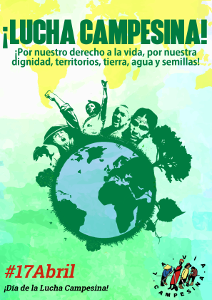
April 17th - International Day of Campesino Struggle From Honduras to Chicago - Fighting for land, food and justice.


On April 17th campesino and all kinds of rural as well as urban land and water rights groups participate  in the International Day of Farmer and Peasant Struggle.  The April 17th date was chosen by the international organization Via Campesina in 1996 to commemorate the massacre of 19 Brazilian peasants organized in the MST (Movement of Landless Workers) in Eldorado dos Carajas , Brazil at the same time as the Via Campesina’s international assembly. This year once again there were activities around the globe including both Honduras and Chicago. A representative from La Voz de los de Abajo attended some of the events in Chicago. 
Article by V. Cervantes

Campesinos in Honduras  - Agrarian Reform Now and Stop Criminalizing Campesinos!

April 17,Tegucigalpa - foto L. Rivera, OnNoticias
In Honduras the campesino organizations that belong to Via Campesina, including the CNTC (National Center for Rural Workers), held a march and a one day occupation of the plaza at the Honduran Congress on April 17th. They are demanding agrarian reform and an end to the criminalization of the campesino movement.  For Honduran campesino and indigenous communities the fight for land, food, and water continues to be framed by violence, evictions, and displacement of their communities. Since the military coup of June 2009 more than 200 campesinos and campesinas have been murdered because of their participation in land struggles.  6,000 campesinos and campesinas have some type of criminal charges against them and are on probation, awaiting trials or in jail related to their activism. The protest condemned the fact that a week earlier, near the northern town of Las Lomitas, 5 members of an organized campesino community that has been on the land for 10 years were arrested and were still in jail as of April 17th. Campesino leaders are emphatic in their analysis that the only solution to violence in the countryside and the repression against the campesinos, as well as a way forward out of poverty in the countryside and food dependency, is an integral, equitable land reform that puts land and meaningful agrarian assistance in the hands of the campesinos. Three years ago the campesino movement in Honduras wrote a real land reform law and got it introduced into the Congress but it was then tabled and has disappeared from sight.   

Also on April 17th, Honduran government authorities accompanied by police arrived for “an inspection” of the embattled CNTC campesino community “9th de Julio” in the province of La Paz. This inspection was supposed to be a surprise and the authorities expected to find only a small number of campesinos on the land at that time. However, the CNTC discovered the inspection plan and the community was accompanied by a large number of other campesinos and supporters in La Paz. CNTC leaders stated that the inspection was part of ongoing intimidation and part of the strategy to displace the campesinos. Fabricio Velásquez, one of the leaders of the community was  interviewed by  Defensores En Linea and stated that the authorities were visibly startled to find so many campesinos and, although the campesinos did nothing to deter the inspection, the officials and police only stayed perhaps 15 minutes. The “9th of July” community is emblematic of the organized campesino struggle in Honduras — they have been evicted more than 26 times in 7 years, 3 times in just the past 12 months. Each time their houses and crops are destroyed, but they return to rebuild and replant, despite the fact that all of the leaders have  criminal charges made against them. La Voz de los de Abajo has visited “9 de Julio”  a number of times and there are several articles in Honduras Resists with more information about CNTC land recuperations. 

April 17th In Chicago: Farmers, Environmental Justice and International Solidarity 
April 17, Chicago, foto Family Farm Defenders

In Chicago, Via Campesina supporters and food sovereignty activists from Family Farm Defenders, Friends of the MST, and Food and Water Watch also held actions and educational forums on April 17th. There were actions at the Chicago Mercantile Exchange during the day to protest that institution's price setting that is driving small dairy farmers out of existence and another action at the offices of TIAA Financial Services against land grabbing pension fund speculation that hurts both small farmers and pensioners.

In the evening a representative from La Voz de los de Abajo attended the educational forums. Joel Greeno (Family Farm Defenders), Jessica Fujian (Food and Water Watch) and Amy Mall (Family Farm Defenders) spoke on food sovereignty and environmental justice, and Jeff Frank of the Friends of the Brazilian MST reported on the International Land Reform Conference held in Brazil in 2016.  He also gave an update on the wave of repression and criminalization of the MST since the 2016 coup against President Dilma Rousseff. Two MST members have been arrested, the MST school was attacked by the police and fighting for land reform is being treated as a criminal conspiracy. 

The speakers drew many connections between the farmers and peasant struggles in South America and Central America with the struggles in the United States including supporting the Native people’s fight to defend water and territories in the US and the No DAPL movement, and the struggles of urban and rural communities for environmental justice and healthy food.
They were familiar with the campesino and indigenous movements in Honduras through groups like Grassroots International and Agricultural Missions that along with La Voz de los de Abajo are members of the Honduras Solidarity Network, and they invited La Voz to given an update on the situation for the campesinos in Honduras and the campaign for support for justice for Berta Caceres, indigenous leader assassinated in 2016.

March 1, Tegucigalpa
foto V. Cervantes
This is one more example of the importance and the possibilities of building more mutual solidarity to confront the attacks on the peoples' movements in the world today. 


For More Information
www.viacampesina.org
www.defensoresenlinea.com
www.mstbrazil.org
www.foodandwaterwatch.org
www.familyfarmdefenders.org
www.foodandwaterwatch.org

Thursday, January 26, 2017

COPINH Calls for Month of Action in March 2017

The Honduran indigenous organization COPINH calls for a month of action demanding justice for Berta Caceres and for the indigenous communities in struggle in Honduras. La Voz de los de Abajo and the other organizations of the Honduras Solidarity Network will be organizing actions, so stay tuned to our Facebook pages and other social media so you can join in.

el español sigue despues del ingles 


“Berta lives on, COPINH is strong” - COPINH calls for month of actions
On March 2nd, 2016 they assassinated our sister Berta Cáceres. They thought they would get rid not just of her as a leader recognized throughout Latin America and around the world, but also would end a struggle, a political project, that they would destroy the organization of which she was both founder and daughter, COPINH (the Civil Council of Popular and Indigenous Organizations of Honduras).

One year since she spread her wings, since the crime that tried to steal her clarity and leadership from us, the peoples of the world who recognize her legacy are here, walking in her footsteps, confronting the patriarchal, capitalist, colonial and racist system that is imposed upon our peoples. We have been and will continue confronting the deadly projects of transnational corporations and imperialism in every corner of the planet.

In March we won’t just painfully remember that horrendous crime, above all we will celebrate life: the life of Berta, who was born on March 4th and the life of COPINH, which was founded 24 years ago on March 27th.

For all of these reasons, we invite you to use every day of March to multiply:

  • Actions of protest, resistance and struggle against the deadly policies of transnational corporations…
  • Actions to defend the bodies and lives of women in the face of the patriarchal and colonial system...
  • Actions against the criminalization of grassroots movements, against militarization and commodification of the lands and all dimensions of life...
  • Actions to denounce the Honduran State in front of its embassies in every country of the world...
  • Actions of solidarity with COPINH and with the organizations of the grassroots Honduran social movement...
  • Actions to spread the thinking and example of Berta’s life…
  • Moments of reflection and spirituality...

We call for these types of actions to be developed and spread through every corner of Abya Yala and the world. As movements, organizations and people, let’s accompany COPINH, embody it, multiply its march.

In all of these potential proposed actions, and all others that your creativity gives rise to, let the world shake with the cry of: “Berta lives on, COPINH is strong!”

In the face of militarization and criminalization, more struggle and organization!

With the ancestral strength of Berta, Lempira, Iselaca, Mota and Etempica, we raise our voices full of life, justice, liberty, dignity and peace.

  
--
BERTA LIVES ON, COPINH IS STRONG
#justixciaparaberta #SoyCOPINH
#bertavivecopinhsigue


Listen live: 
fb:     Copinh Intibucá twitter: @COPINHHONDURAS


Convocatoria del COPINH a la jornada “Berta Vive, el COPINH sigue”

El 2 de marzo de 2016 asesinaron a nuestra hermana Berta Caceres. Creían de esta forma acabar no solo con la lideresa reconocida en todo el continente latino americano y el mundo, sino acabar con una idea, con una lucha, con un proyecto político; acabar con la organización de la que fue fundadora e hija a la vez, el COPINH (Consejo Cívico de Organizaciones Populares e Indígenas de Honduras).

Al cumplir un año de su siembra, del crimen que quiso arrebatarnos su claridad y su liderazgo, los pueblos del mundo que reconocemos su legado estamos presentes, caminando tras sus huellas; enfrentando el sistema capitalista, patriarcal, colonial y racista que se impone en nuestros pueblos. Seguimos y seguiremos enfrentándonos a los proyectos de muerte de las transnacionales y del imperialismo en cada rincón del planeta.

En marzo no solo recordamos con dolor aquel horrendo crimen, sino que sobre todo celebramos la vida: la de Berta, que nació un 4 de marzo; y la del COPINH, que el día 27 de marzo cumple 24 años de su fundación.

Por todo ello, invitamos a que cada mes de marzo se multipliquen:

.acciones de protesta, resistencia y lucha en contra de las políticas de muerte de las corporaciones transnacionales...
.acciones de defensa de los cuerpos y las vidas de las mujeres frente al sistema patriarcal y colonial...
.acciones contra la criminalización de los movimientos populares, contra la militarización y contra mercantilización de los territorios y de todas las dimensiones de la vida...
.acciones de denuncia contra el Estado de Honduras frente a sus embajadas en cada país del mundo...
.acciones de solidaridad con el COPINH y con las organizaciones del movimiento popular y social hondureño...
.acciones de difusión del pensamiento y ejemplo de vida de Berta...
.momentos de reflexión y espiritualidad...

Invitamos a que en los distintos rincones del Abya Yala y del mundo se multipliquen y desarrollen este tipo de acciones. Que desde nuestros movimientos, organizaciones y a título personal, acompañemos al COPINH, lo acuerpemos, y multipliquemos su caminar.

Para todas estas posibles acciones propuestas, y para todas las que la creatividad pueda desarrollar, convocamos a que este 2 de marzo de 2017 el mundo vibre con el grito: “Berta Vive, el COPINH sigue”.

¡Frente a la militarización y criminalización, más lucha y organización!

Con la fuerza ancestral de Berta, Lempira, Iselaca, Mota, y Etempica se levantan nuestras voces llenas de vida, justicia, libertad, dignidad y paz

-- 
BERTA VIVE, COPINH SIGUE
#justixciaparaberta #SoyCOPINH
#bertavivecopinhsigue


escuchenos en vivo: 
fb:     Copinh Intibucá
twitter: @COPINHHONDURAS

Sunday, October 4, 2015

"We can't be indifferent to the defense of our environnment"

Chance for Justice: Trujillo, Colon
October 4, 2015
Environmental Justice in Honduras
V. Cervantes

The retrial of Chabelo Morales Lopez is recessed until October 19th; our group remains accompanying the family in the community of Guadalupe Carney but we decided to make a visit to the small city of Trujillo close to Guadalupe where we arrived in the middle of the "day of the environment" action.

Trujillo is an old Spanish colonial city right on a beautiful bay on the sea. It is a part of the Garifuna coast where the Garifuna people have ancestral rights to the coast under international and national agreements. It is on the edge of of the Aguan Valley's fertile palm growing region, home to thousands of campesinos and their communities as well as to the wealthiest landowners in the country like Miguel Facusse, Reynaldo Canales and Rene Morales: perpetrators of incredible violence against campesino and Garifuna groups in the region.

Another piece of the land conflicts in the region has to do with the struggle to protect the environment and includes the concerns of most of the residents of the area about the destruction caused by mining, tourism and mega-agricultural projects.

The action we saw today was part religious procession, part parade and part protest march with several hundred people carrying placards and banners, children dressed as animals riding on colorfully decorated "floats" created on pick-up trucks. The paticipants were Garifunas, campesinos, school children, nuns, and a variety of Trujillo residents. I spoke with one of the participants who told me the Catholic church in Trujillo was the main organizer of the action with the participation of a lot of different people.  They were chanting slogans such as "no puede ser indiferente--a la defensa del ambiente" (you can't be indifferent to the defense of the environment) and against the new (2013) mining law which granted more concessions to private mining companies. Around 35% of the total country is now concessioned to mining and hydroelectric projects. Communities, especially indigenous and rural communities, all over Honduras are resisting displacement and/or the contamination of their water and soil. In the Trujillo area there are dozens of mining concessions that the people oppose. We talked earlier in the week to one of the long time campesino leaders at Guadalupe Carney who is part of a regional group organizing to resist the mining companies and the Honduran government and keep mining out of the area.

Another big environmental and land tenancy issue is related to the attempts
to develop mega-tourism in the area. Randy Jorgensen (the Canadian porn king millionaire) is one of the highest profile "developers". He is leading an aggressive and threatening push to displace the Garifuna communities in the Trujillo area so that he and his investors can take over the beaches for cruise ship landings and high end large tourist resorts. This kind of development  degrades the fragile environment in the area as well as displacing the indigenous Garifuna from their land and destroying their way of life and stability.  So far the communities have resisted despite threats of violence and it was good to see the different groups whose lives are affected joining together.

The UK based group, Global Witness, issued a report earlier this year that showed that Honduras has had the highest per capita rate of people murdered because of their activities to defend the earth and environment, for each of the past five years, than any other country in the world. In 2014, three quarters of these murders were in Central and South America, including 12 in Honduras. Global Witness reported that world-wide these murders and conflict in general are increasing because of the intensifying competition over land and land use and the fact that the lack of government action to protect people or environment is putting the ordinary residents and their organizations on the front lines of the conflict.


Friday, March 7, 2014

Attempted Murder of Indigenous Leader and Family in Rio Blanco


Report from SOAW Observer in Honduras Brigitte Gynther with additional information added by La Voz de los de Abajo. Original Spanish communique from COPINH linked above.
Yesterday (March 5, 2014)  7 people tried to kill Maria Santos, seriously attacking her, her 12-year old son Paulo, and her husband Roque, with a machete.  Maria is a vocal leader in the struggle in Rio Blanco and member of the Indigenous Council.  Maria has received numerous death threats because of her vocal opposition to the Agua Zarca Dam.  Yesterday, around midday, she was on her way home from making food at the school when 7 people who were hiding in wait came out, surrounded her and attacked her with machetes, rocks, and sticks.  Her husband had been calling her as she walked home because of the constant threats she received, and when he heard she was surrounded, he and her son ran out.  Her husband pled with them not to kill her and when her son ran to try to help his mom, the people attacked her 12-year old son as well, cutting off his right ear and part of his face.  His cranium is fractured.  They also attacked her husband who was also seriously injured.  All three are in the hospital.  Maria is a strong member of COPINH Rio Blanco resistance, despite receiving death threats including threats from the people who attacked her yesterday.  

The indigenous community in Rio Blanco has been fighting for  2 years against the construction of a dam that privatizes and destroys the  Gualcarque River  and will flood lands that are part of the indigenous patrimony in the region. The DESA Company (Honduran) , first in partnership with Chinese state owned company SINOHYDRO which has now withdrawn from the project, has used private paramilitary guards, paid assassins, Honduran military and National Police to attack, murder and intimidate the community. In August of 2013 another community activist Tomas Garcia was shot and killed by soldiers. Indigenous leaders and members of the Lenca organization COPINH have faced criminal charges for their involvement in the struggle for environmental and indigenous rights. 


Rio Blanco community meeting with La Voz delegation July 2013

Monday, July 15, 2013

Honduran Army Kills Compañero Tomas García of COPINH

Below is a communique issued by COPINH earlier today. Since its publication the surviving victim of the military shooting, Allan Garcia Dominguez has been transferred to the hospital in San Pedro Sula in critical condition. 

More information in Spanish - Informacion en español

Today, July 15, in the morning (around 9:45 am), the Honduran Army killed compañero Tomas García, a member of the Indigenous Council and auxiliary of the community, an active member of COPINH, a respected compañero, very prudent and a fighter, a compañero who never gave in to the pressures from the company DESA and SINOHYDRO. We condemn this brutal action that once again puts the Lenca population of Río Blanco into mourning. Furthermore the bullets from the soldiers’ rifles hit the youth Lenca, Allan Garcia Dominguez, son of compañero Tomas who is in delicate condition and was transferred to the Hospital of Santa Barbará. 

This act was committed while the community was on its way, as always during these 106 days of resistance, to a peaceful blockade in front of the installations for the hydroelectric project of DESA and SINOHYDRO. 

We demand that the National Police, the Public Ministry and other entities immediately capture and bring to judgement the criminals . 

Compañero Tomas García, present, present today, tomorrow and always!


Friday, July 5, 2013

Human Rights Crisis in Río Blanco / Crisis de Derechos Humanos en Río Blanco

Military in Río Blanco community in unmarked truck without plates.
en español 


HUMAN RIGHTS CRISIS IN RÍO BLANCO

To the Honduran and international media
To national and international human rights authorities
To the Inter-American Commission on Human Rights
To the President, Congress and Supreme Court of Honduras
To the Honduran public and international community

We are extremely worried about the deterioration of the already volatile situation in Rio Blanco, in particular the militarization of the area and recent accusations made in the Honduran media against indigenous Lenca community members and their supporters by the police and the SINOHYDRO and DECA companies who seek to build the Agua Zarca dam on the Gualcarque River near Rio Blanco. Blood has already been shed and there is grave danger of a broader bloodbath in the near future. Many media reports have irresponsibly repeated serious claims and accusations that police themselves admit have yet to be corroborated and we have serious questions regarding the official version of events and express our concern in the strongest terms possible about the potential worsening of violence, intimidation, repression, criminalization and legal persecution.

We are a 15-person delegation of international Human Rights observers organized by La Voz de los de Abajo, an organization that has been working for 15 years accompanying social justice movements in Honduras and reporting on human rights violations. Our delegation is made up of teachers, youth and experienced human rights observers from Chicago, Illinois, United States. We are in communication with the United Nations Working Group on Paramilitary Activity and members of the United States Congress as well as human rights monitors around the world. We visited Rio Blanco on July 2nd and 3rd, 2013 to investigate allegations of human rights abuses, intimidation and violence faced by the indigenous Lenca community of Rio Blanco because of that community’s opposition to the construction of the Agua Zarca hydroelectric dam by the Chinese company SINOHYDRO and the Honduran company Desarrollos Energéticos (DECA) as well as the allegations made against Rio Blanco community members, the Rio Blanco Indigenous Council, and the organization with which the community is affiliated, the Civil Council of Popular and Indigenous Organizations of Honduras (COPINH), including its General Coordinator Berta Cáceres.
COPINH coordinators Berta Cáceres and Doña Pascualita conversing 
with Río Blanco Indigenous Council about the cultural and spiritual
significance of the Gualcarque River for the Lenca indigenous
people and the non-violent struggle to defend it

Our delegation was able to interview dozens of members of the community of all ages, representatives of the Rio Blanco indigenous council and COPINH, as well as police, military, administration and personnel of DECA and SINOHYDRO, and community members employed by the company. We were witness to a lengthy and democratic discussion by over 100 community members facilitated by the Indigenous Council of Rio Blanco together with COPINH about the offers made by the company to the Rio Blanco community. We were witness to the community’s overwhelming decision not to accept anything less than the withdrawal of the Agua Zarca dam and the foreign companies seeking to build it and repeated insistence on their right to consultation and respect for their cultural and spiritual rights under Convention 169 of the International Labor Organization of the United Nations. 

The community has been blocking one of the access roads to the site for the dam construction for over 90 days. Numerous community members including children, youth, adults and elders during separate interviews shared the same concerns and versions of events about numerous acts of repression and intimidation that have occurred since the beginning of the blockade including:

Children who are present every day at Río Blanco blockade listening in
and participating in assembly of Indigenous Council and COPINH about
company offers. These children told of being threatened by military/police
.

  • Over 150 police and military appearing at the blockade on Sunday June 23rd and pointing high caliber automatic weapons at small children and elders
  • Police and military arbitrarily entering the homes of many community members and circulating the community with heavy armament intimidating community members
  • Residents of a nearby community allegedly employed by the dam company intimidating people at the blockade, arriving at the site appearing drunk and wielding machetes and making death threats to community leaders and supporters
  • A machete attack on one community member leaving him in grave condition missing part of his hand and with a severely disfigured face. This community member was in the hospital at San Pedro Sula at the time of our visit
  • The targeting of supporters of the blockade by military and police operations, the most recent of which was on the first day of our delegation’s visit when Berta Cáceres and other members of COPINH on their way to Río Blanco were stopped, told to all exit their truck, yelled at and searched, as has happened on numerous other occasions  
  • Death threats against Berta Cáceres, Aureliano Molina, Tomas Gomez, Francisco Javier Sanchez, Lucio Sanchez and other members of the community
  • Close collaboration with private security by the national police and military, who are supervising the company’s privately contracted guards and are being housed and fed by the company as well as using company vehicles. We believe this negatively affects any possibility of the military and police acting objectively and it serves as a further intimidation of the community who see the company as controlling the national security forces. 

Human rights delegation interviewing engineer for Agua Zarca dam as
well as police, military and community members collaborating with them.
On the morning of July 3rd we conducted a thorough interview with police, military and company administration and personnel as well as community members who were with them on company property and were identified to us as family of the person accused of the recent machete attack. The police and dam engineer claimed that on the night of Saturday June 29th there were shots fired at the site of dam construction next to the Gualcarque River and that the night of July 2nd (the night before we interviewed them) at approximately 8pm there were shots fired at the cafeteria and offices for the company at the site across from the blockade. Our delegation was present at the blockade until 7pm at which point we went to the town of Rio Blanco because a severe storm with a heavy downpour of rain and loud and frequent thunder and lightening that lasted well into the night. According to the engineer and police version of events, they heard shots and hit the floor, though they mentioned nothing of the thunder and rain storm that was taking place at the exact time of the alleged gun fire and showed us no bullet shells or bullet holes. They explicitly blamed Berta Cáceres, General Coordinator for COPINH, for inciting the alleged violence, saying, “every time she comes something happens.” They had no answer when asked if she was present before the alleged gunfire on Saturday. They had nothing to say about the judge throwing out their last case against her due to lack of evidence. Our delegation explained that throughout the meeting at which she was present on Tuesday afternoon she repeatedly reminded people that the Rio Blanco struggle has been and must remain a non-violent struggle. Our delegation asked the police, military and company personnel if they had interviewed any community members opposed to the dam about the alleged violence and they said that they had not. Our delegation asked them if they had looked into the possibility of involvement from potentially competing interests in the Gualcarque River such as the Grupo Terra energy company associated with Miguel Facussé’s son-in-law Freddy Nasser, which has expressed interest numerous times in building a dam on the Gualcarque River. They responded that they had not. Our delegation asked if they would be providing jobs to those community members that had been collaborating with the company. They said that they would provide as many as they could, looked at the community members who were amongst them and nodded reassuringly.

As we were finishing the interview, two truckloads of additional police from Santa Barbera bearing high caliber automatic weapons arrived and they informed us that more were on the way, supposedly to investigate the alleged gunfire of the previous night.

Military in company truck at Agua Zarca plant headquarters.
The day after we left, accusations appeared in the mainstream Honduran media accusing the community of Rio Blanco and COPINH of somehow making their way past all of the police, military and private security and burning down part of the infrastructure of the dam site. The police appear in these reports also accusing COPINH and Rio Blanco community members of additional gunfire. The mainstream media reports are using the word “terrorism” and denouncing community members for supposed use of violence, mentioning only briefly that community members repeatedly say that their struggle is non-violent and the only thing they carry are the machetes they carry as work instruments.  The only firearms our delegation saw or heard of the entire time we were present in the community, at the blockade, in the very small houses of key community leaders and around the site of the company were the high power weapons wielded by the army, police and private security. 

We call into question the credibility of the allegations being made against COPINH and the Rio Blanco community and the credibility of the limited investigations by the police. The police and military we spoke with claimed to be there for the general safety of the area yet are staying on company premises, guarding company property, being fed by the company and are very friendly with both company administrators and the handful of community members employed by the company. The spokesperson for the local residents employed with the company was introduced to us as a family member of the person involved in the machete attack that sent one community member to the hospital. He and the police said that attack was in self-defense because the now-hospitalized community member was supposedly trying to “knock down his house” but said they couldn’t show us any evidence of that supposed attempt and more importantly the police said they had not spoken to any of the other community members opposed to the dam about that incident.

We call for the de-militarization of the Rio Blanco community and surrounding areas and remind the Honduran and international authorities as well as the DECA and SINOHYDRO companies of the duty to consult indigenous peoples about projects that affect them and respect their cultural, spiritual and land rights as is clearly outlined in Convention 169 of the International Labor Organization of the United Nations. We also remind the authorities that Berta Cáceres has precautionary measures from the Inter-American Human Rights Commission of the Organization of American States as a high-risk target of repression and that unsubstantiated implicit and direct accusations against her, COPINH and Río Blanco community members by police and media are contributing to a climate of fear and intimidation. The numerous death threats against her and other community members and supporters should not be taken lightly nor should the possibility that accusations against them are fuelling these threats and the overall climate of repression, intimidation and criminalization. We fear that the current media campaign is aimed at criminalizing COPINH and the Río Blanco community in order to justify further human rights violations.

As human rights observers we will continue to closely monitor the situation and eagerly await a response from the Honduran state, media, local and national police, the U.S. government (who provides funding to the Honduran military and police), the Chinese company SINOHYDRO, the Honduran company DECA and regional, national and international human rights bodies to the human rights crisis unfolding at Rio Blanco. 

La Voz de los de Abajo
Published from El Progreso, Honduras July 4th, 2013

See call to action with list of contact info for national and international authorities
---------------------------------------------------------------------

Related Posts with Thumbnails